
Mavic 4 Pro Field Report: Tracking Urban Vineyards
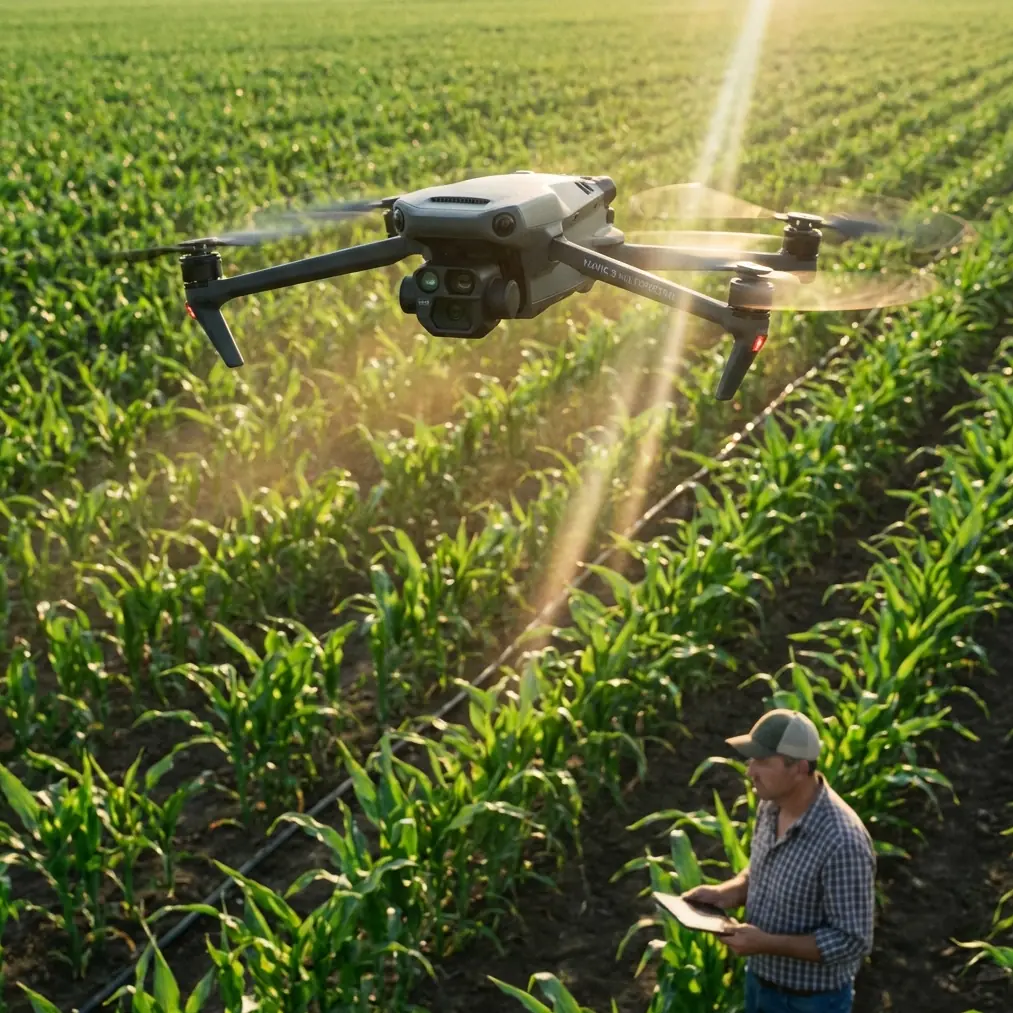
Mavic 4 Pro Field Report: Tracking Urban Vineyards with Pipeline-Grade Inspection Logic
META: A field report on using Mavic 4 Pro for urban vineyard tracking, applying proven UAV inspection methods like planned autonomous routes, visible-light review, thermal verification, and real-time ground assessment.
Urban vineyards are awkward places to survey well.
They sit between roads, retaining walls, utility corridors, rooftops, drainage lines, and reflective surfaces that confuse both the eye and the map. Walk the rows and you get intimacy but poor coverage. Climb to a nearby building and you gain context while losing detail. Drive the perimeter and you miss what matters in the middle.
That tension is exactly why the most useful way to think about the Mavic 4 Pro is not as a lifestyle camera drone, but as a compact aircraft that can borrow operating discipline from professional corridor inspection. A pipeline solution document from Tianjin Tengyun Zhihang Technology, a subsidiary of Hi-Target, lays out a method that is surprisingly relevant here: plan the route first, run autonomous visible-light inspection, send data back to the ground station in real time, then let the field team make decisions from live evidence rather than guesswork.
For tracking vineyards in an urban setting, that workflow matters more than any marketing spec sheet.
I spent a recent morning testing this logic over a narrow vineyard parcel edged by apartments on one side and a service road on the other. The assignment sounded simple: document vine vigor, identify row gaps, check edge encroachment, and create footage usable both for management review and visual storytelling. In practice, it was classic low-altitude complexity. Wind tunneled between buildings. Sun bounced hard off nearby windows. A line of trees brought intermittent shadow across the canopy. And halfway through the second pass, a pair of egrets lifted from an irrigation channel and crossed the flight path just ahead of the aircraft.
That wildlife moment told me more about the value of sensor-driven flight than any bench test could. The Mavic 4 Pro’s obstacle awareness and tracking intelligence didn’t just help preserve a shot. They reduced cockpit workload at the exact moment attention had to split between airspace, subject continuity, and environmental movement. In an urban vineyard, where the scene is alive with poles, wires, trellis geometry, and occasional birds, that margin is operationally meaningful.
Why pipeline inspection methods fit vineyard tracking
The source material describes a visible-light inspection process with three core steps: route planning, autonomous flight inspection, and real-time data transmission to a ground station for immediate judgment. It also highlights a separate infrared workflow, where thermal imagery is used to detect anomalies that are not obvious in standard visual review. Both ideas translate cleanly to urban vineyard work.
Start with route planning. In the pipeline document, the aircraft is not launched casually. The team plans the inspection line first. That sounds basic, but it is the dividing line between random drone footage and usable aerial evidence. When I fly a Mavic 4 Pro over vines, I build the mission around row direction, sun angle, expected shadow movement, likely wind drift, and points where the site narrows near structures. The result is repeatability. You can revisit the same rows, from the same direction, at the same altitude envelope, and compare footage over time instead of relying on memory.
Then comes autonomous or semi-automated execution. The pipeline reference emphasizes autonomous flight inspection for checking damage and omissions. In a vineyard, the equivalent is spotting missing vines, uneven growth, irrigation irregularities visible at canopy level, and edge effects caused by hardscaped urban boundaries. When the aircraft can hold a predictable track while you focus on image interpretation, you stop flying for novelty and start flying for diagnosis.
Finally, there is the real-time ground decision loop. The source text repeatedly mentions live transmission to the ground station so field personnel can assess the inspection as it unfolds. That point is easy to overlook until you work with growers, site managers, or urban agriculture teams who do not want a post-produced cinematic recap; they want actionable visibility now. A stable downlink from the Mavic 4 Pro lets the person on the ground call for a closer pass over a weak row, a slower orbit around a drainage corner, or a top-down check of a suspected gap before the aircraft leaves the area.
That is the difference between collecting content and running an aerial survey.
Visible-light inspection is still the first pass
The pipeline solution makes a strong case for visible-light inspection because it covers large areas, offers flexible angles, and captures richer detail than manual line-of-sight walking. That logic absolutely holds in urban vineyards.
My first pass was a structured visible-light run along the outer boundary, not the interior rows. I wanted the management context first: how the vineyard sat relative to pavement, walls, rooftops, parked vehicles, and shade lines. The Mavic 4 Pro excels here because obstacle avoidance is not just a safety feature; it encourages tighter composition around constraints. When you are tracing the boundary of a site where vine health may be affected by adjacent construction runoff or reflected heat from neighboring surfaces, those near-edge angles matter.
From there, I shifted into row-following work using ActiveTrack selectively. This is one of those features that people often discuss in terms of following cyclists or cars, but in agricultural and urban horticulture work, the more interesting use is controlled movement along a structured subject line. In practice, I used it less to “track” a moving object and more to maintain consistent relational framing as the drone advanced along trellis geometry and terrain changes. A manual pilot can do this too, of course. The advantage of good tracking assistance is consistency across repeated monitoring flights.
QuickShots and Hyperlapse entered the workflow later, and not as gimmicks. QuickShots were useful for creating short, standardized reveal sequences that quickly established spatial relationships for stakeholders unfamiliar with the site. Hyperlapse was valuable for showing changing shadow progression over the vines as nearby buildings shifted the light. In an urban vineyard, temporal change is often as important as static condition. A brief Hyperlapse can explain exposure stress or shade timing better than a paragraph in a report.
Thermal thinking changes what you look for
One of the more practical details in the source material is the role of infrared inspection in finding concealed faults through temperature anomalies. The document frames this around line inspection and night emergency response, noting that thermal systems help teams identify fault points quickly and gain precious time. For vineyard work, the exact task is different, but the principle is the same: thermal contrast can reveal what the eye misses.
I am not claiming every urban vineyard mission requires thermal payload logic. Many do not. But the inspection mindset is useful. If a visible-light pass shows one section of vines lagging or one corner retaining moisture differently, the next question is whether the anomaly is superficial or systemic. Thermal review, where available in the broader operational workflow, can help identify stress patterns, irrigation inconsistencies, heat accumulation near masonry, or drainage effects after late-day sun exposure.
What matters most from the source is not the hardware brand it cited. It is the method: pair visible-light inspection with thermal verification when hidden issues are likely. In other words, don’t trust beauty shots to tell the whole agronomic story.
Borrowing from mapping workflow improves repeat surveys
Another detail from the reference deserves more attention. The document’s terrain-mapping section describes a sequence that includes field reconnaissance, route planning, aerial image collection, and acquisition of POS data with a fixed-wing aircraft carrying a Sony A7r. That is a serious mapping chain, built for large-scale terrain output rather than a compact urban site. Even so, the lesson is relevant for Mavic 4 Pro operators: recon first, structure the capture, and preserve spatial consistency.
I walked the site before launch and marked three issues that would have been easy to underestimate from the air alone: a sagging trellis segment hidden by leaves, a service alley with sporadic delivery traffic, and a roofline that produced a deceptive wind shear at one corner of the block. That reconnaissance changed the mission plan. I raised altitude slightly on one leg, shifted the turn point on another, and delayed the low tracking sequence until after the delivery window passed.
This is where many vineyard drone flights go wrong. People assume the aircraft sees everything. It does not. It sees what the mission allows it to see. The pipeline and mapping reference gets this right by putting site understanding before data capture.
The wildlife encounter was the real test
Back to those egrets.
They lifted suddenly from the channel at the edge of the property, crossing left to right in front of the drone while I was running a slow oblique pass intended for canopy continuity review. This was not dramatic in a cinematic sense. It was operationally inconvenient, which is exactly why it mattered. Urban agricultural sites attract birds, and birds do not care about your mission timing.
The Mavic 4 Pro’s sensing and obstacle awareness gave me enough confidence to prioritize clean separation and controlled repositioning without abandoning the inspection logic. Instead of climbing abruptly and ruining the pass, I slowed, adjusted laterally, and resumed with only a minor framing reset. For anyone tracking vineyards near water features, parks, or mixed-use city green space, this is not a side note. It is part of the job.
Subject tracking features are often judged by how elegantly they follow something intentional. I judge them by how gracefully they let you recover when the environment stops cooperating.
D-Log is not just for pretty footage
Because this was also a photographer’s assignment, I captured key sequences in D-Log. Not because every vineyard manager wants a graded film, but because urban vineyards are tonally difficult. Hard reflections from windows, dark vegetation under shade, pale stone walls, and bright sky can break a standard profile quickly. D-Log preserves flexibility in those high-contrast scenes and lets you pull back detail in leaf texture or surrounding infrastructure without clipping the highlights beyond recovery.
That has practical value. If you are trying to show whether a row is thin because of plant stress or simply hidden under transient shadow, latitude matters. Good color information is not vanity. It supports interpretation.
What the Mavic 4 Pro does well in this niche
For urban vineyard tracking, the Mavic 4 Pro makes the most sense when treated as a bridge between imaging and inspection.
It is compact enough to deploy quickly in constrained sites. It has the sensing intelligence to work safely around physical clutter. Its tracking tools can support repeatable row documentation. Its imaging profile can handle difficult contrast. And when you run it with the discipline borrowed from pipeline inspection—planned route, visible-light first pass, live review, anomaly follow-up—it becomes much more than a camera in the sky.
The source document from Tianjin Tengyun Zhihang Technology points to a broader truth that applies well beyond pipelines: UAV value comes from workflow design. The aircraft can gather high-resolution data, transmit it in real time, and support faster decisions than manual inspection alone. In that document, one branch of the workflow used a fixed-wing iFly U3 with a Sony A7r for area aerial capture, while another used a rotary-wing iFly D1 with image transmission for closer inspection and live monitoring. That split between broad coverage and agile close review is exactly how I would think about the Mavic 4 Pro in an urban vineyard. Use it first to understand the site as a whole, then use it to interrogate what stands out.
If you are setting up a similar monitoring routine and need a practical flight-planning conversation, you can message our UAV team here.
The biggest mistake I see is assuming vineyard tracking is mostly about following rows and collecting attractive footage. In an urban site, it is really about reading interactions: vines against built surfaces, shadows against growth, access paths against safety constraints, and changing conditions against a repeatable aerial baseline. Once you approach it that way, the Mavic 4 Pro starts to look less like a creative accessory and more like a compact field instrument.
That is where it earns its place.
Ready for your own Mavic 4 Pro? Contact our team for expert consultation.