
Mavic 4 Pro on a Solar Farm at Dusk: A Field Report on Low
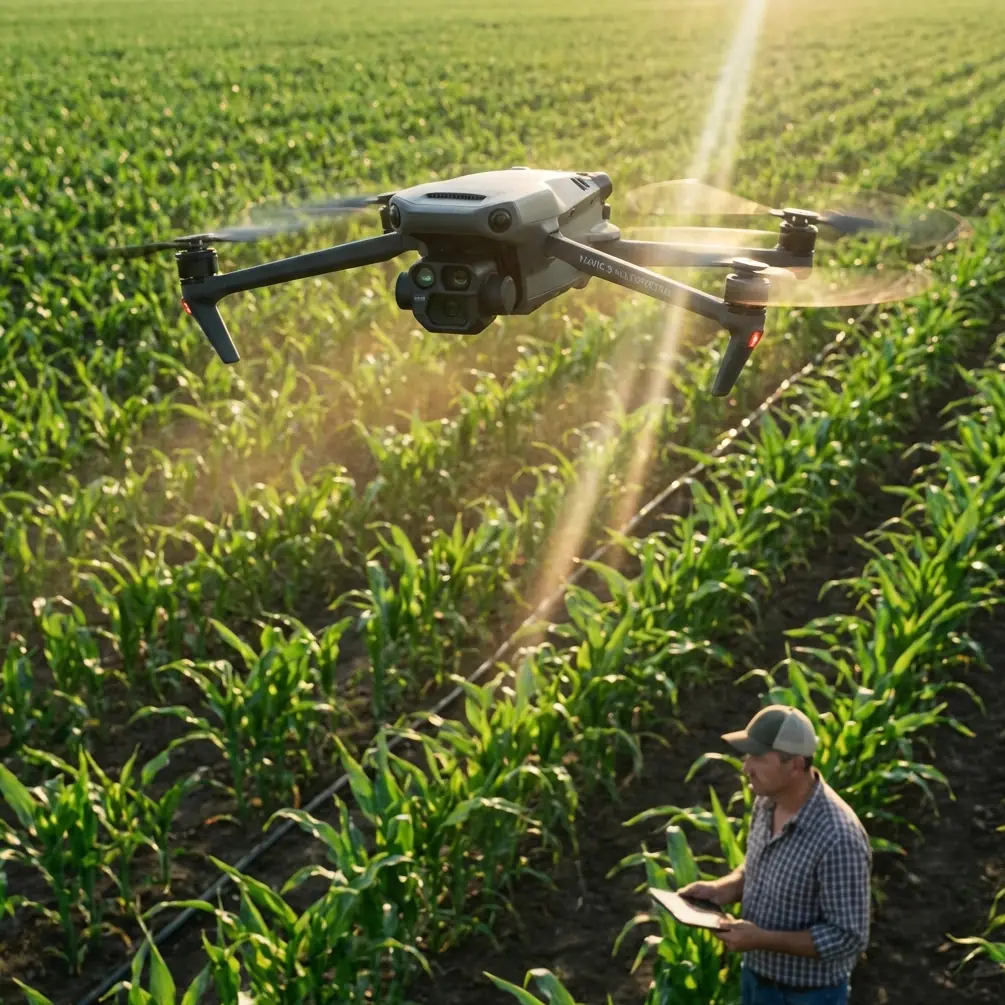
Mavic 4 Pro on a Solar Farm at Dusk: A Field Report on Low-Light Tracking, Mapping Discipline, and Why Workflow Matters
META: A field-tested look at using Mavic 4 Pro for solar farm work in low light, with practical insight on tracking, mapping workflow, image overlap, accuracy, and deliverables.
Solar farms look simple from the highway. Long rows. Repeating geometry. Open land. Easy, at least until the sun drops and the job starts asking harder questions.
That’s when a drone stops being a camera with propellers and becomes part of a survey workflow. For teams tracking construction progress, panel alignment, drainage issues, vegetation encroachment, or maintenance access routes, low light changes everything: exposure margin tightens, shadows get longer, and repetitive panel patterns can confuse both pilots and software. This is exactly where the Mavic 4 Pro becomes interesting.
I’m approaching this as a field report, not a spec-sheet rewrite. The useful question isn’t whether the Mavic 4 Pro can fly over a solar site. Plenty of drones can. The real question is whether it can keep delivering dependable imagery and trackable data when light is fading and the project still needs outputs that stand up in planning meetings the next morning.
The first mistake operators make on solar sites
They think the mission starts with takeoff.
It doesn’t. It starts with the map.
A standard drone mapping workflow begins by importing a base map, defining the coverage area as a rectangle or polygon, and setting the target ground sampling distance. That one step alone determines more than many pilots realize. In the reference workflow, a target of 5 cm per pixel leads to an automatically generated flight altitude of 162 meters with the cited aircraft and camera setup. Even if the exact altitude differs on a Mavic 4 Pro because of sensor and lens differences, the operational principle is the same: GSD drives altitude, altitude drives single-flight coverage, and both shape the final dataset.
On a solar farm, that matters because you are almost always balancing resolution against time on site. If the task is broad progress monitoring, you may accept a coarser GSD to cover more hectares in one mission. If the task is detecting alignment inconsistencies, cable trench changes, localized pooling, or edge damage near panel tables, resolution has to take priority. Low light makes that balancing act tighter, because slower shutter speeds and longer shadows can undermine the detail you thought you were capturing.
The Mavic 4 Pro earns its place here by making this planning mindset practical rather than theoretical. It is the sort of platform that can serve both the visual inspection side and the structured capture side of a solar operation. That dual role is something many competing drones struggle with. Some are great for cinematic image quality but become awkward inside disciplined mapping routines. Others are efficient mapping tools but produce flat, less flexible footage when the operations team also needs compelling visual documentation for stakeholders. The Mavic 4 Pro sits in the middle in a way that’s unusually useful.
Low light is not just a camera problem
A lot of pilots reduce dusk performance to sensor size, ISO tolerance, or color profile. Those matter, especially if you are shooting in D-Log and trying to preserve highlight and shadow information across reflective panel surfaces. But on solar farms, low light also stresses navigation and composition.
Rows of nearly identical panels can become a visual trap. Depth cues flatten. Access roads disappear into shadow. Small service structures emerge late. If obstacle avoidance is weak or overly hesitant, the aircraft becomes harder to trust near fencing, inverter blocks, or perimeter trees when you’re working the edge of a site after sunset glow.
This is where the Mavic 4 Pro has a practical advantage over lesser consumer-oriented aircraft. Better obstacle avoidance is not just about preventing impacts. It reduces pilot workload during repeated perimeter passes and allows more mental bandwidth for checking framing, overlap, and route discipline. On a large solar site, that reduction in cognitive load is real. You feel it in the second and third mission of the evening, when fatigue starts to nibble at judgment.
The same goes for ActiveTrack and subject tracking. On paper, that sounds like a creative feature. In the field, it can be a documentation tool. Tracking maintenance vehicles along service roads, following an inspection team between panel rows, or creating consistent visual progress records of construction movement becomes far easier when the drone can hold a reliable lock without constant manual correction. Many competitor drones claim similar tracking capability, but in repetitive environments like solar arrays, consistency is the separator. A drone that loses the subject against repeating geometry wastes battery cycles and breaks continuity. A drone that holds track cleanly saves the operator from fighting the machine.
Why overlap and geotags matter more than dramatic footage
Solar farms invite pretty footage. Long leading lines. Symmetry. Metallic reflections. Hyperlapses across a sunset shift can look outstanding, and yes, the Mavic 4 Pro’s QuickShots and Hyperlapse modes can help teams produce polished progress media with minimal setup. But if you stop there, you’ve only used half the tool.
The stronger use case is a capture workflow built to support mapping and model generation. The reference process emphasizes setting image overlap high enough for stereoscopic coverage. That’s not a bureaucratic detail. It is what allows software to reconstruct terrain and structures reliably enough to generate orthomosaics and 3D point clouds.
Each image in the workflow carries geotagged data: the 3D GPS coordinates of the image center plus the camera’s three orientation angles at the moment of capture. That bundle of metadata is operational gold. On a solar farm, it means repeated missions can be aligned and compared with much more confidence. If vegetation growth near fence lines is becoming a concern, if drainage channels are changing after seasonal rain, or if installation phases need to be checked against engineering plans, geotagged imagery becomes traceable rather than anecdotal.
This is one reason the Mavic 4 Pro stands out against competitors that are marketed heavily on image appeal alone. Good-looking frames are nice. Reliable positional context is better. For asset owners and EPC teams, what matters is whether today’s flight can be compared with last month’s dataset without guesswork.
Accuracy is where the workflow stops being casual
The reference material gives two numbers that deserve attention.
First, it cites absolute X, Y, Z accuracy of 3 cm / 5 cm when the workflow is properly configured. Second, it states that 2D orthomosaic and 3D model relative accuracy typically falls within 1–3 times the GSD.
That tells you something important about expectations. Drone data is not magic. It is structured, bounded, and dependent on planning quality. If your mission is set at 5 cm/pixel, your relative model precision is shaped by that decision. If your overlap is weak, if your control is poor, or if your low-light images soften because shutter speeds drag too far, your deliverables will show it.
This is where Mavic 4 Pro operators need to be disciplined. If you want solar farm outputs that support genuine decisions, don’t treat dusk as a casual visual window. Treat it as a constrained data collection environment. Keep motion blur under control. Watch for specular glare off panel faces. Confirm overlap rather than assuming it. And check the site before you leave, not after you get back to the office.
The reference workflow specifically mentions generating an on-site image quality report in Postflight Terra 3D to verify image quality and coverage before producing orthomosaics and 3D point clouds. That habit is more valuable than any isolated feature. Solar sites are usually large, and a missed strip in the middle of an array can turn a seemingly successful mission into a return visit. In fading light, that return visit may cost you the exact lighting conditions you needed to compare against prior flights.
Ground control, RTK thinking, and what that means in practice
Another detail from the source is easy to overlook: with an RTK-enabled setup, ground control points may not be necessary. That does not mean control strategy becomes irrelevant. It means the workflow changes.
For solar farm operators, this is significant because laying and surveying GCPs across an active or partially built site takes time, labor, and coordination. If your aircraft and workflow support high-confidence positioning directly, you can move faster, especially on recurring monitoring missions. Less time placing targets means more time capturing useful imagery before the light collapses.
At the same time, experienced operators know there’s a difference between “not required” and “never beneficial.” On sites where engineering-grade alignment matters, where terrain variation is tricky, or where you need tighter confidence for change detection, control strategy still deserves thought. The Mavic 4 Pro benefits most when it’s used by teams who understand this nuance. The aircraft can streamline the work, but it won’t replace survey judgment.
A solar farm is repetitive. Your deliverables can’t be.
The standard workflow ends where many drone articles begin: outputs.
Orthomosaics. 3D models. Digital elevation products. Contours. Reference points. Segmentation lines. Volume analysis for stockpiles. Export formats such as GeoTIFF, OBJ, DXF, SHP, LAS, and KML tiles.
For solar work, these are not abstract file types. They map directly to departments. Engineering may need a GeoTIFF for site context. Construction managers may want a 3D model to verify staging progress. Environmental teams may rely on elevation data to assess runoff behavior. Asset managers may use consistent orthomosaics to track vegetation and road wear over time.
This is another place where the Mavic 4 Pro can outclass competitors in practical value. If a drone captures beautiful dusk footage but does not fit smoothly into downstream deliverables, it becomes a marketing tool, not an operations tool. A platform that can support both field visuals and structured geospatial outputs has a much longer useful life inside a solar organization.
If your team is building that workflow and wants to compare approaches for recurring site capture, a direct project conversation often helps more than another generic buying checklist; this is the point where a quick message via our field workflow desk makes sense.
What I would actually do with a Mavic 4 Pro on a low-light solar assignment
I’d split the mission mentally into two products.
First, the data pass. Planned route. Defined polygon coverage. GSD selected based on the inspection goal. Overlap set with stereoscopic reconstruction in mind. Controlled speed to protect sharpness. Conservative decision-making around the last usable light. The objective here is not drama. It is a clean orthomosaic-ready dataset with dependable geotags and enough consistency to compare against previous flights.
Second, the communication pass. This is where Mavic 4 Pro’s more advanced visual intelligence starts paying off. ActiveTrack for vehicle movement or technician walkthroughs. Hyperlapse for site-wide timeline storytelling. D-Log for preserving tonal flexibility as the sky cools and panel reflections become harder to balance. Obstacle avoidance engaged not as a crutch, but as support for confident low-altitude movement around inverters, fencing, and access corridors.
That two-pass mindset is the difference between a drone flight and an aerial documentation program.
Where Mavic 4 Pro really separates itself
Not on one headline feature.
Its edge is that it can bridge the gap between image-led and workflow-led operations. On a solar farm in low light, that matters more than raw hype. The job is rarely just to “capture content.” It is to return with material that can be used, checked, exported, compared, and trusted.
The source workflow highlights this clearly: automatic route generation, image acquisition points, embedded GPS and camera attitude metadata, image quality verification, orthomosaic and point cloud production, and final exports into industry-standard formats. Those steps describe a professional chain of custody for aerial data. The Mavic 4 Pro becomes valuable when it fits into that chain without making the operator choose between visual quality and operational discipline.
For photographers moving into industrial work, that’s a major shift. The eye still matters. Composition still matters. But repeatability matters more. The best solar farm drone work isn’t the shot that gets applause on social media. It’s the dataset that helps a team make a confident decision before the next weather window closes.
And if I had to sum up the Mavic 4 Pro in that environment, I’d put it this way: some drones make low-light flying feel cinematic; this one has the potential to make it useful.
Ready for your own Mavic 4 Pro? Contact our team for expert consultation.