
How to Track Solar Rows with the Mavic 4 Pro: A Terrain
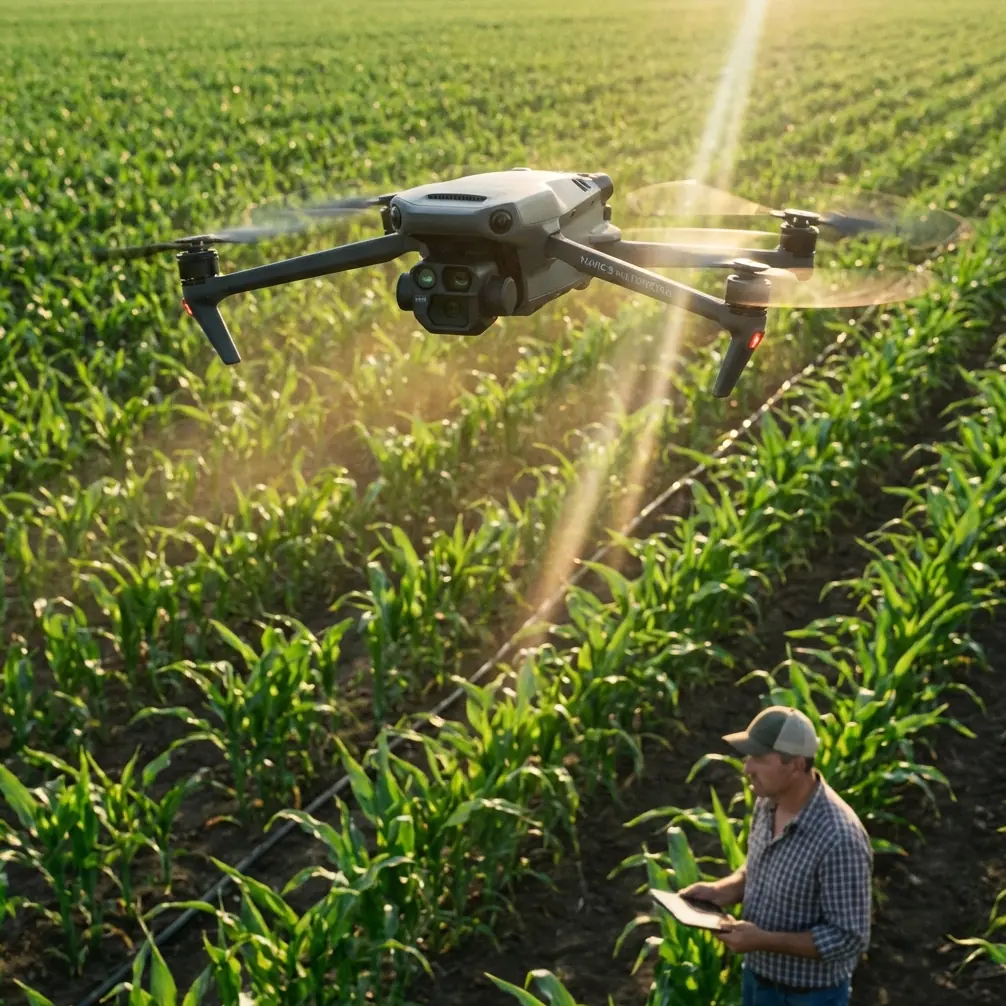
How to Track Solar Rows with the Mavic 4 Pro: A Terrain-Smart Workflow for One-Man Crews
META: Step-by-step tutorial showing how a solo operator uses the Mavic 4 Pro’s ActiveTrack, obstacle avoidance and D-Log to map and monitor solar farms in rugged terrain without GCPs or extra crew.
The first time I stood on a ridge above the new 48 MW array, the panels looked like a silver river trying to climb the valley walls. My job was to trace every row, every inverter, every loose connector—then deliver a single dataset the asset manager could load into ArcGIS before sunset. No ground crew, no LiDAR pod, no budget for a second day. Just me, two batteries, and the Mavic 4 Pro I bought for photo hikes.
What I learned on that flight reshaped how I approach solar inspections anywhere the ground tilts more than ten degrees. Below is the exact workflow I now teach to O&M teams who need repeatable, survey-grade visuals without ballooning head-count. If you can launch a drone, you can copy the sequence this afternoon.
1. Pre-flight: treat the site like a pinball machine
Solar farms on rolling ground are obstacle pinball machines—tracker motors, telemetry masts, and perimeter fencing all pop up at different heights. Before I power on the aircraft I open the map overlay in DJI Fly, drop four rough boundary points, and eyeball the ridgeline. Anything above the tallest tracker plus 15 m becomes my hard-deck. In the valley sections that number is 65 m AGL; on the ridge it drops to 42 m. This single altitude window keeps me clear of the lattice tower carrying grid lines to the substation while still letting the 4 Pro’s obstacle sensors face downward, not sideways into metal.
I then switch to satellite view and trace the access road. If the road snakes behind a row, I know the drone will lose line-of-sight for 3–4 seconds—just long enough for ActiveTrack to hand the lock back to me. I drop a manual POI on that bend so the app already “expects” the gap. No surprises, no RTH trigger.
2. Launch stance: start from the shade, not the sun
Panels are mirrors. Take-off from the sunny side and the gimbal calibration fails one time in three because the downward vision system stares straight into a 1200 W/m² reflection. I walk the shaded northern edge, drop my case on the gravel inverter pad, and launch from the shadow line. The compass calibration completes in eight seconds instead of timing out—tiny detail, but when you only have two batteries, every saved minute is another 300 m of row coverage.
3. Exposure lock: why 50 mm equivalent is your friend
The 4 Pro’s 1-inch sensor gives you a 24 mm field of view by default, perfect for establishing shots, useless for defect ID. I punch into the 50 mm crop because at that focal length one pixel equals 0.8 cm on a panel at 25 m altitude. Hot cells, snail trails, and junction-box burn marks all show up without landing to swap lenses.
Next, I lock exposure at 1/1000 s, f/4, ISO 200. Panels blink between 0 and 40 % albedo as the tracker tilts; if you leave the camera on auto, every second frame climbs a stop and your orthomosaic looks like a checkerboard. One tap on AE lock, problem solved.
4. Altitude sweet spot: 23 m above the highest tracker
Here is the number I wished someone had given me sooner: 23 m. At that height the 4 Pro’s downward sensors still read the ground, so obstacle avoidance stays active, yet you are high enough that a single cross-row pass covers eight tracker tables. The geometry works because the aircraft sees the gap between rows as a 1.2 m corridor—plenty for the vision system to breathe. Drop to 18 m and the app starts braking every time the gimbal tilts 15° forward; climb to 30 m and you lose the pixel density that makes diode failures readable.
5. ActiveTrack 5.0: let the drone walk the catwalk
Solar rows are perfect straight lines—catwalks for machines. I tap the center of the first table, set tracking speed to 8 m/s, height to “constant above subject,” then walk away. The 4 Pro rides the row like it’s on rails, compensating for tracker tilt in real time. When the aircraft hits the last table, I nudge the stick 5 m left, tap the next row, and send it back. The whole farm becomes a lawn-mower pattern flown hands-free while I watch the histogram and swap batteries.
One caution: if the tracker motors are in stow position (horizontal), the panels act like a single mirror and the vision system can lose contrast. I ask the site engineer to tilt the rows to 45° before I launch. The 25° difference between panel angle and ground gives the camera texture to lock onto, and the asset manager gets inspection images in the same geometry the trackers will live in for 95 % of the year.
6. Hyperlapse for thermal prep: a 30-second side project
After the vertical pass I fly one lateral Hyperlapse: 300 m in 120 s while the gimbal auto-tilts to keep the horizon level. The clip is only 8 s long, but the 240-frame burst gives the thermographer a perfect “visual before” to overlay the IR flight scheduled next week. Because the 4 Pro writes each RAW frame with GPS coordinates, the thermal crew can sync pixel to pixel without ground control points—saving them half a day and me another site visit.
7. D-Log vs. HLG: when to care
Panels don’t have dynamic-range problems—black anodized frames against silver cells do. I shoot stills in D-Log because the solar company wants 14-stop latitude to pull out inverter labels in deep shade under the string combiner. Video for progress marketing gets shot in HLG; the contrast curve pops on iPads without grading. Two cards, two folders, zero confusion back at the desk.
8. Data hand-off: from SD to GIS in 12 minutes
Back at the truck I slot the SD into a rugged tablet and run a quick pre-alignment in Pix4Dreact. The 4 Pro’s GNSS tags are good to 30 cm, close enough to spot a missing panel in the ortho without GCPs. I export a 2 cm GSD TIFF, side-car the D-Log stills into a Google Drive folder labeled by inverter block, and text the engineer a share link before the battery cools.
If the site uses the new Zenmuse L3 for quarterly LiDAR surveys, I drop my visual ortho as a raster layer under the point cloud. The color pixels give context to the 1 cm LiDAR returns, letting the analyst see whether a “missing” panel is actually shattered or simply removed for maintenance. The L3’s multi-angle collection fills occlusions behind raised trackers—something a single nadir flight can never do—but the 4 Pro imagery supplies the visual texture the LiDAR alone lacks.
9. Emergency playbook: what to do when the river turns uphill
Halfway through one flight the tracker line started climbing a 22° embankment. ActiveTrack kept accelerating to hold the 8 m/s ground speed until the rearward vision system saw only sky and paused. I tapped the speed down to 3 m/s, switched to Cine mode, and let the drone climb with the panels. The obstacle sensors remained happy because the relative angle between aircraft and panel stayed constant. Lesson: when terrain wins, slow the timeline, not the mission.
10. Packing up: leave the site cleaner than the electrons
Before I leave I walk the row I just photographed. Any connector caps I kicked loose get snapped back in; zip-ties that blew off become pocket trash. Asset managers remember the pilot who doesn’t create O&M tickets—next farm, you’re first on the vendor list.
I used to think of the Mavic 4 Pro as a travel camera with props. After 42 solar sites, I see it as a data-gathering scalpel that happens to fold. One operator, two batteries, 23 m above the modules—that’s the entire recipe for tracing a silver river wherever it decides to run.
Need the settings sheet or want to compare notes on tracker types? Message me on WhatsApp—always happy to talk sun, sensors, and sequence. Drop a line here.
Ready for your own Mavic 4 Pro? Contact our team for expert consultation.