
Expert Tracking With Mavic 4 Pro in Mountain Fields: A Real
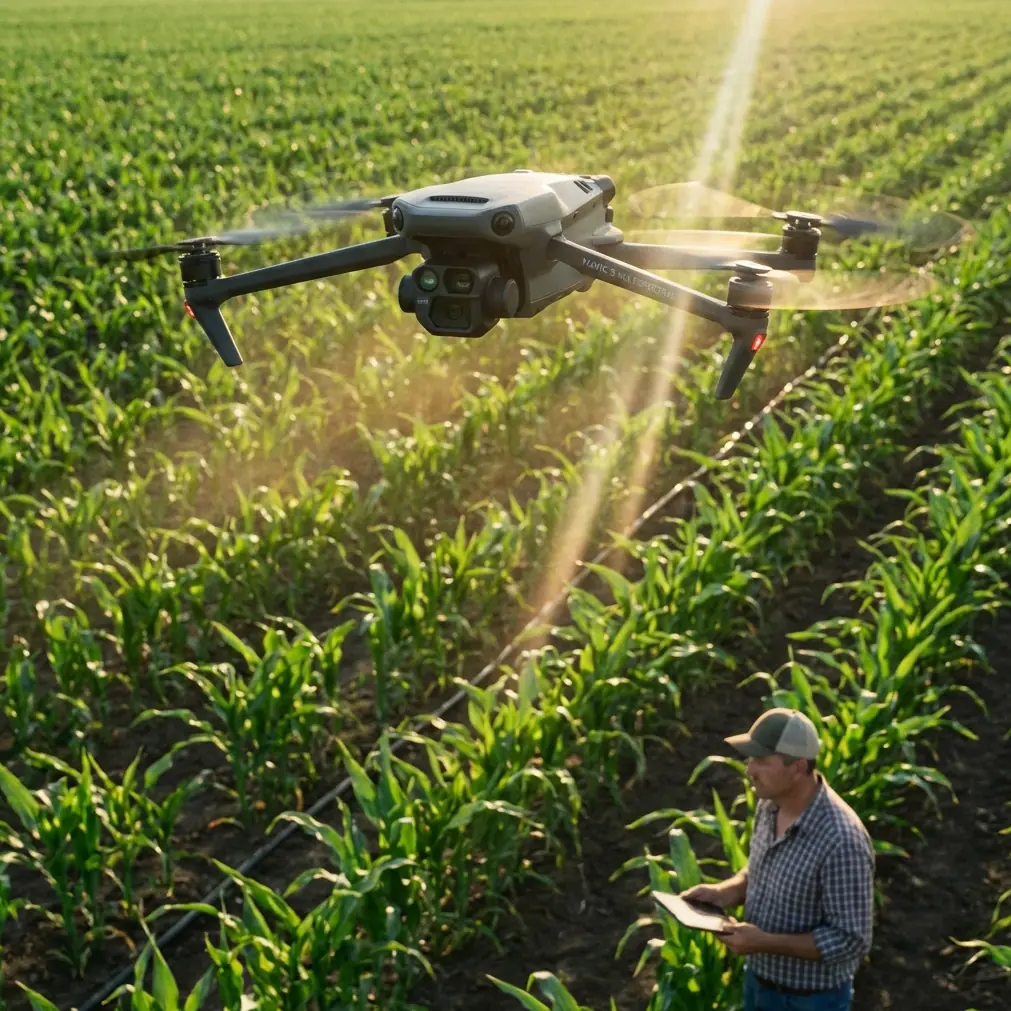
Expert Tracking With Mavic 4 Pro in Mountain Fields: A Real-World Case Study
META: A field-tested case study on using the Mavic 4 Pro for tracking work in mountain terrain, with practical insight on obstacle avoidance, ActiveTrack, D-Log, Hyperlapse, and why it stands out for agricultural monitoring.
Mountain agriculture exposes every weakness in a drone system.
Flat farmland is forgiving. Mountain fields are not. Elevation changes distort depth perception, ridgelines interrupt signal paths, terraces create awkward sightlines, and tree lines can appear suddenly when you shift from one contour to the next. If your goal is tracking crop conditions across sloped ground, irrigation paths, or worker movement between fragmented plots, the aircraft has to do more than simply fly well. It needs to see, adapt, and hold a clean line while the environment keeps changing underneath it.
That is where the Mavic 4 Pro becomes interesting.
This is not a generic “best drone” discussion. The focus here is one specific scenario: tracking fields in mountain terrain, where the operator needs a reliable visual platform for repeated runs, terrain-aware movement, and footage that can still be used later for analysis, reporting, or client presentation. In that setting, features like obstacle avoidance, ActiveTrack, QuickShots, Hyperlapse, and D-Log stop being marketing terms and start becoming operational tools.
The assignment: follow the land, not just the subject
A recent mountain-field workflow I built around the Mavic 4 Pro was designed for a simple brief on paper: document a sequence of terraced growing areas, track the movement corridor between them, and create footage that could serve both monitoring and communication purposes.
Simple on paper. Messy in reality.
The plots were split across uneven elevations. A direct path between points was visually obvious from the ground but less straightforward in the air. Trees rose above retaining edges. A small utility shed sat partially hidden near one terrace. Narrow lanes forced conservative flight behavior. Wind behaved differently at each altitude band.
This is the type of terrain where many competing drones are technically capable, yet practically tiring. They may track well in open conditions, but once the background becomes cluttered and the elevation changes start compressing perspective, the pilot often has to take over constantly. That breaks continuity. It also reduces the value of tracking footage if your objective is repeatability across multiple site visits.
The Mavic 4 Pro’s edge in this kind of work is not one single spec. It is the way automation, sensing, and imaging support each other.
Why obstacle avoidance matters more in mountains than in open fields
Obstacle avoidance is often discussed as if it were a beginner safety net. In mountain-field operations, that undersells it badly.
The real value is trajectory confidence.
When you are tracking along a slope, the aircraft is not just dealing with a static obstacle map. It is working in a scene where relative distance changes fast. A line of trees that looked comfortably offset can become a collision risk after a slight lateral repositioning. A retaining wall may sit below the aircraft at one moment and rise into its path as the terrain climbs.
With the Mavic 4 Pro, obstacle sensing contributes directly to smoother tracking decisions in these compressed spaces. That matters because smoothness is not only about aesthetics. It affects the usefulness of the footage for field review. Abrupt corrections make it harder to evaluate row condition, drainage patterns, vehicle access paths, and worker transit routes. Stable pathing gives the operator cleaner visual records and less need to scrap clips afterward.
Compared with weaker tracking platforms that hesitate, drift, or abandon the route too early when background clutter increases, the Mavic 4 Pro is better suited to terrain where the safe route is constantly being recalculated. In mountain agriculture, that translates to less interruption and more complete runs.
ActiveTrack in mountain fields: where it earns its keep
ActiveTrack has obvious value when following a moving vehicle, worker, or inspection path. But in mountain terrain, its deeper value is cognitive relief.
The operator already has enough to manage: slope relationship, wind, signal line, safe standoff distance, return path, and changing sun angle. If the drone can reliably maintain subject awareness while the pilot supervises the bigger picture, the entire mission becomes more controlled.
On the Mavic 4 Pro, ActiveTrack is particularly useful when the “subject” is less about a cinematic hero shot and more about documenting movement through agricultural infrastructure. Think of a small utility vehicle moving between terraces, or a worker walking irrigation lines from one elevation band to another. You are not just filming motion. You are recording how the site actually functions.
That distinction matters.
Some competing drones can lock onto a subject in open areas, but they become less convincing when the subject passes near trees, structures, or abrupt terrain shifts. In mountain fields, those interruptions happen all the time. The Mavic 4 Pro’s stronger combination of tracking and obstacle awareness means the operator can stay focused on maintaining legality and visibility rather than constantly re-acquiring the target.
For repeated site documentation, that reliability also improves consistency. You can revisit the same route and generate more comparable footage over time, which is useful for crop growth monitoring, access planning, erosion observation, or seasonal reporting.
QuickShots are not just for flashy edits
QuickShots tend to be dismissed by serious operators, which is a mistake.
In a commercial mountain-field workflow, QuickShots can save setup time when you need short, structured visual sequences for progress updates or stakeholder summaries. A carefully used automated move can reveal terrace geometry, slope steepness, road access, and crop spacing faster than a manually flown shot that requires multiple takes.
The operational advantage is efficiency. You can capture a clear establishing sequence without devoting unnecessary battery time to repeated framing attempts. In mountain environments, battery discipline matters more because route planning is rarely as straightforward as it is on flat sites. Every extra hover and reposition eats into your margin.
The Mavic 4 Pro fits this use because it allows you to move from practical tracking work into polished overview capture without changing platforms. That reduces kit complexity and keeps field teams faster on site.
Hyperlapse has real monitoring value on sloped farms
Hyperlapse is another feature that gets boxed into “creative” use, but there is a practical side to it in mountain agriculture.
When weather moves across elevation zones, the change can be dramatic and uneven. Light shifts over terraces differently. Fog rolls in bands. Shadows from adjacent ridges alter visibility over sections of the property long before the whole site darkens. A Hyperlapse sequence can document these transitions in a way that still photography often cannot.
For operators building reports around field access, moisture behavior, or visibility windows, that condensed time perspective has real value. It can help show how workable conditions evolve across a hillside during a morning or late afternoon period.
The Mavic 4 Pro is well suited here because you can capture Hyperlapse material as part of a broader mission rather than as a separate creative detour. The aircraft’s stability and imaging tools make that transition practical. On a mountain site where time in the air is precious, combining operational documentation with presentable visual outputs is a genuine advantage.
D-Log is not just for colorists
D-Log deserves a more grounded explanation than it usually gets.
In mountain fields, contrast is often brutal. Bright sky, reflective leaf surfaces, deep cut shadows, pale soil patches, and dark tree belts can all sit in the same frame. Standard color modes can produce footage that looks fine at first glance but limits what you can recover later when preparing a site review or a client-facing summary.
D-Log gives you more room in post-production to balance those extremes. That is operationally significant because footage captured for agriculture or land management often gets repurposed. One day it is used for internal analysis. Next week it appears in a progress presentation. Later it may support a planning discussion with contractors or landowners.
If the image falls apart in highlights or blocks up in the shadows, its usefulness narrows quickly.
This is one area where the Mavic 4 Pro stands above lighter-duty consumer competitors that may be easy to fly but offer less serious grading flexibility. In mountainous terrain, where the visual range inside a single scene can be severe, D-Log is not a luxury. It is a buffer against difficult light.
A practical flight sequence that worked
For one mountain-field session, the most effective sequence looked like this:
First, a high overview pass to establish terrace layout and identify risk points near tree margins and structures. Then a lower tracking run using ActiveTrack along the main movement path between plots. After that, a controlled lateral pass to inspect boundary edges and access lanes. We finished with a short QuickShot-style reveal and a Hyperlapse segment as cloud movement changed the light over the upper terraces.
That sequence produced two different kinds of output from one flight window. The first was practical field documentation. The second was polished visual material that could be shown to stakeholders without another site visit.
The reason this matters is simple: mountain operations punish inefficiency. If one aircraft can handle tracking, scene awareness, obstacle management, and grade-friendly footage in a single workflow, your team spends less time swapping systems or compromising on results.
Where the Mavic 4 Pro pulls ahead of competitors
The comparison point is not whether other drones can technically perform these tasks. Many can. The difference is how much intervention they demand once the terrain stops being simple.
In open flatland, smaller or less sophisticated aircraft may seem close in performance. In mountain fields, the gap widens. Obstacle-rich backgrounds expose weak subject tracking. Uneven topography exposes shaky route control. Harsh contrast exposes limited image flexibility.
The Mavic 4 Pro excels because it handles these overlapping pressures better as one integrated platform. ActiveTrack is more useful when obstacle avoidance is trustworthy. D-Log becomes more valuable when your shots are stable enough to preserve continuity. QuickShots and Hyperlapse become more than decorative extras when they can be captured within a serious field mission.
That integration is the real story.
What operators should watch before launching
Even with a capable platform, mountain-field work demands discipline.
Check wind at multiple elevations, not just at takeoff point. Expect the visual relationship between drone and terrain to mislead you as the slope rises. Leave wider margins around tree lines than you think you need. Avoid relying entirely on automation near ridges or signal-shadow areas. Build your route so the return leg is not the first time you consider terrain clearance.
The Mavic 4 Pro gives you a better margin for this work, but it does not erase the fundamentals.
If you are designing a mountain-field workflow and want a practical second opinion before deployment, it can help to message a drone specialist directly and sanity-check the mission structure.
The bigger lesson from this case
The Mavic 4 Pro makes the most sense when you stop thinking about features as isolated checkboxes.
Obstacle avoidance is about maintaining useful continuity in constrained terrain. ActiveTrack is about reducing pilot workload during complex monitoring runs. QuickShots can shorten capture time for structured updates. Hyperlapse can reveal environmental change across elevation bands. D-Log protects footage quality when mountain light becomes difficult.
Put those together and the aircraft becomes unusually effective for tracking fields in challenging topography.
That is why it stands out. Not because it promises everything, but because in a mountain environment it solves several real problems at once. For agricultural teams, land managers, content crews documenting rural infrastructure, or consultants building repeatable reporting workflows, that combination is hard to ignore.
A lot of drones look competent on spec sheets. The Mavic 4 Pro proves itself when the field stops being flat.
Ready for your own Mavic 4 Pro? Contact our team for expert consultation.