
Mavic 4 Pro on Remote Solar Farms: What Fixed
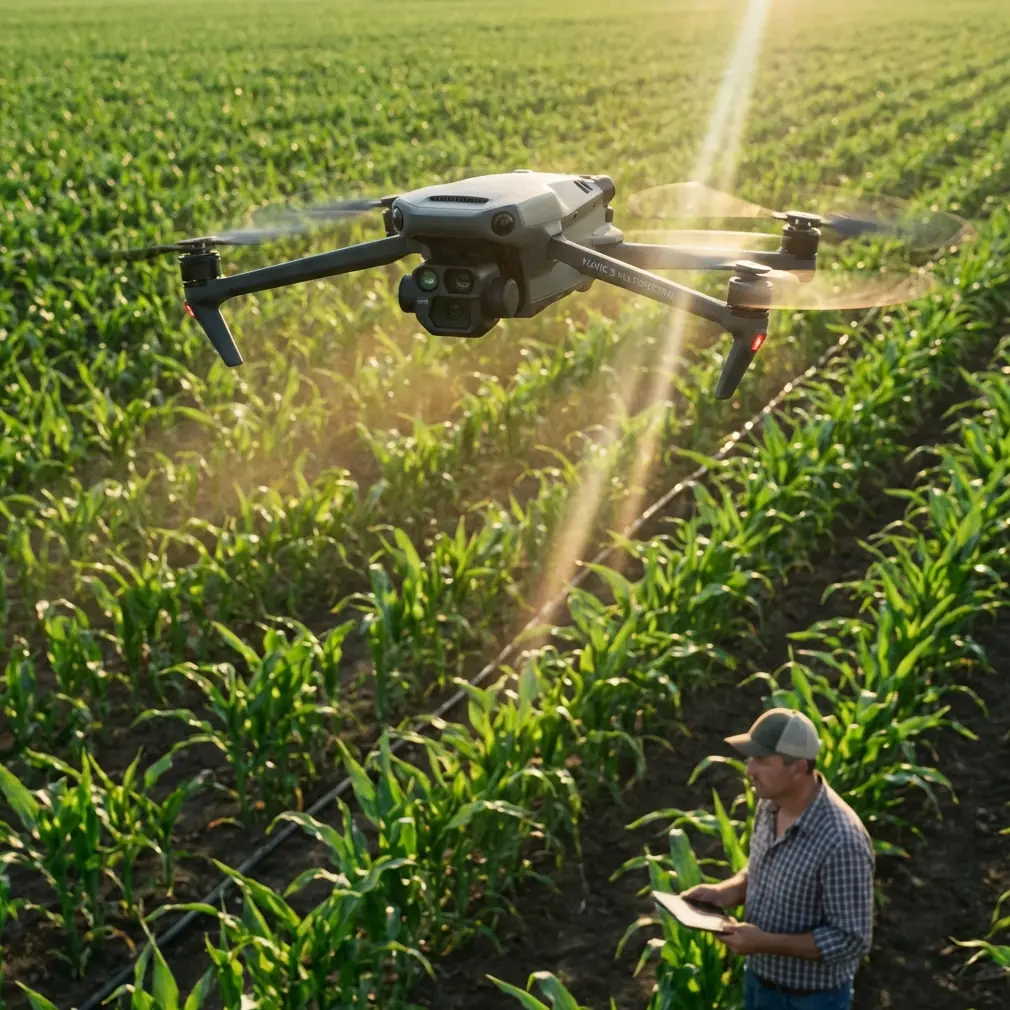
Mavic 4 Pro on Remote Solar Farms: What Fixed-Wing Aerodynamics Still Teach Us About Safer Low-Altitude Work
META: A technical review of how Mavic 4 Pro pilots can apply core stall, lift, and control-surface principles to safer low-altitude operations around remote solar farms.
Remote solar sites punish sloppy flying.
Panels create glare. Long table rows compress your depth perception. Wind often behaves differently at the edge of an open array than it does over scrubland or service roads. And when you are working far from immediate support, every flight decision matters more. That is why the most useful way to think about the Mavic 4 Pro in this environment is not as a consumer camera drone with premium automation, but as an aircraft that still obeys basic aerodynamic truths.
The reference material behind this article focuses on fixed-wing flight rather than multirotors. At first glance, that may seem disconnected from a Mavic 4 Pro. It is not. If anything, remote solar-farm operations become safer when pilots understand where classic winged-aircraft theory still applies, where it does not, and what that means for altitude, positioning, and flight behavior over large, repetitive infrastructure.
Why a solar-farm pilot should care about stall theory
One of the most important reference points is the description of a spin developing when one wing stalls before the other. The source explains that when one side stalls first, the aircraft can rotate toward that wing along its longitudinal axis, creating a spin or autorotation event. In traditional fixed-wing flying, that is an extremely dangerous condition, and some aircraft are specifically designed to avoid entering it because recovery can be difficult.
A Mavic 4 Pro is not a fixed-wing aircraft, so it does not enter a classic wing stall-spin sequence in the same way. Still, the operational lesson is directly relevant: asymmetric airflow and abrupt control inputs near obstacles can create unstable moments much faster than many pilots expect.
On a solar site, that matters in three specific ways:
Low-altitude turns over panel rows
When flying close to arrays, pilots often tighten lateral corrections to stay aligned with inspection or spraying paths. Even if the Mavic 4 Pro remains electronically stabilized, aggressive roll and yaw corrections in turbulent air can produce uneven rotor loading and brief attitude instability. The fixed-wing lesson is simple: avoid situations where one side of the aircraft is working much harder than the other unless there is a good reason.Wind gradient near reflective infrastructure
Airflow over rows of panels is not always uniform. As wind crosses one bank of modules and spills into access lanes, the aircraft may encounter uneven lifting or sinking air. A fixed-wing aircraft would be vulnerable to one wing approaching stall first. A multirotor responds differently, but the principle remains: non-uniform air is where pilot smoothness becomes a safety tool.Overconfidence in automation
Obstacle avoidance and subject tracking are valuable, but they do not repeal aerodynamics. If the aircraft is operating in glare, dust, or lateral crossflow between structures, the pilot still needs a margin. Automation can support judgment; it cannot replace it.
The best altitude for remote solar-farm work with Mavic 4 Pro
If you only take one practical idea from this review, make it this: for remote solar-farm passes, the best working altitude is usually the lowest altitude that preserves a clean sensor view and stable airflow margin, rather than the lowest altitude physically possible.
For most panel-row work, that often means flying roughly 3 to 6 meters above the top edge of the array, then adjusting higher when wind becomes mechanically disturbed or when glare starts degrading obstacle perception. That number is not a universal rule, but it is a strong starting point.
Why this range works:
- It keeps the aircraft close enough for detailed visual documentation.
- It gives obstacle sensing more time to interpret row geometry.
- It reduces the need for constant micro-corrections compared with ultra-low skimming.
- It leaves a buffer above unexpected protrusions, wiring irregularities, comms poles, or uneven terrain transitions.
- It limits the visual flattening effect that happens when you fly too high and lose row-by-row precision.
Pilots who fly lower than that often do so chasing detail they could have preserved with framing, lens choice, or a slower groundspeed. In remote sites, low-altitude bravado is rarely the smart trade.
If the mission involves documenting washdown, vegetation intrusion, access-lane condition, or broader site context before or after maintenance work, you can step up to a higher band. But for row-following flights, that 3 to 6 meter envelope usually balances detail, control margin, and predictable handling.
Lift still matters, even on a multirotor mission
The reference document makes another useful point: lift is mainly generated by circulation, and wing shape has a major effect on lift-to-drag behavior. It contrasts the near-symmetrical airfoils common on subsonic aircraft with the more cambered glider-style profiles, such as a Clark Y-like section, used to improve lift and extend endurance.
That detail is about fixed wings, yet it helps us understand a common mistake in drone operations: assuming endurance is just a battery question.
It is not. Endurance is also a drag-management question.
On a Mavic 4 Pro over a solar farm, you do not have wings optimized like a glider’s long slender planform, but you absolutely still pay for drag. Fast strafing, repeated braking, hard yaw inputs, and unnecessary altitude cycling all consume energy. In a remote environment, those behaviors shrink your reserve exactly when you may need extra margin for a reroute, return leg, or weather change.
The glider comparison tells us something operationally important: aircraft stay aloft longer when their aerodynamic burden is reduced. For a multirotor, the equivalent is cleaner path planning and less wasted motion.
That means:
- build longer, straighter passes rather than twitchy zigzags;
- avoid needless stop-and-go repositioning;
- use repeatable lane spacing;
- keep camera objectives clear before launch so you are not re-flying rows;
- and let intelligent modes help only when they genuinely reduce pilot workload.
This is where features often associated with media creation, such as ActiveTrack, QuickShots, Hyperlapse, or D-Log, need to be treated with discipline. They are not the center of a solar-farm workflow, but they can support it in narrow cases. ActiveTrack can assist with following a moving maintenance vehicle for site documentation. Hyperlapse can show crew progression or weather movement over a large array. D-Log can preserve highlight and shadow detail in high-contrast panel environments. The point is not to turn an industrial flight into a cinematic exercise. The point is to use these tools only when they improve interpretation without increasing flight complexity.
Control logic: the old language still helps
The source also states that ailerons, elevator, and rudder provide the roll, pitch, and attitude moments needed for flight. Again, the Mavic 4 Pro does not use those same mechanical surfaces. But this old framework is still excellent mental training.
When flying remote infrastructure, think in those three axes anyway:
- Roll discipline keeps your lateral movement measured when tracking panel rows.
- Pitch discipline prevents unnecessary acceleration and braking cycles.
- Yaw discipline matters around narrow lanes where over-rotating the aircraft can disrupt obstacle sensing and framing.
That mental model is better than simply “flying by screen feel.” It forces the pilot to see motion as a set of controlled forces, not just stick movements. Better pilots do this instinctively. They are not merely steering. They are managing attitude, momentum, and sensor orientation at the same time.
What the spin-recovery passage really teaches Mavic 4 Pro operators
The reference text includes the classic fixed-wing spin recovery logic: reduce power, apply opposite rudder, stop the rotation, then recover from the stall. No, you will not perform that exact sequence on a Mavic 4 Pro. But the logic is still useful because it shows the correct order of thinking in an upset:
- Stop making the condition worse
- Counter the unwanted motion
- Recover to stable flight
- Only then resume the mission
That sequence is gold for solar-farm work.
If your aircraft gets unsettled by a gust at the end of a row, or obstacle sensing behaves conservatively in glare, or your screen image makes closure rate look wrong, the right response is not to salvage the shot. It is to arrest the instability first. Back out. Re-establish height. Reset your heading. Then try again with more margin.
Pilots lose aircraft because they try to complete the line while the aircraft is already telling them the environment has changed.
Obstacle avoidance over solar arrays: useful, but not magic
Solar farms create a peculiar obstacle environment. Rows can be repetitive enough to confuse depth cues, and reflective surfaces can distort how confidently a pilot reads closure. That is where obstacle avoidance has real value on the Mavic 4 Pro. It can add a layer of protection during row transitions, backward movement, or oblique inspection angles.
But it works best when the pilot gives it room to succeed.
If you are flying so low that the system has little time to interpret geometry, or you are crossing row ends with fast combined roll-yaw movement, you are asking the system to solve a problem you created. This is another reason the earlier altitude recommendation matters. A few extra meters can be the difference between smooth path continuity and constant braking behavior.
For crews planning recurring site work, it is often worth standardizing altitude bands and lane offsets before the first full mission day. If you want a practical workflow benchmark for that kind of planning, this is the kind of thing I usually suggest teams discuss in advance through a quick mission brief or a direct WhatsApp coordination note: https://wa.me/85255379740
Why remote sites reward glider thinking
The source spends time on gliders for a reason. Gliders survive on efficiency. They need high lift-to-drag performance, slender wings, and careful energy use to remain airborne longer. Their whole design philosophy is: do not waste motion.
That is a healthy mindset for Mavic 4 Pro operations over remote solar fields.
Even though your aircraft is powered, distance from support changes how you should fly. Efficiency becomes a risk-management habit, not just a battery-saving trick. The smoothest crew usually finishes with cleaner data, fewer surprise battery swaps, less heat stress on equipment, and lower pilot fatigue.
Remote work punishes improvisation. It rewards repeatability.
A technical operating profile that makes sense
For a Mavic 4 Pro mission around remote solar infrastructure, a solid profile usually looks like this:
- launch from a clear service area with strong GNSS visibility;
- climb to a conservative transit height before descending into work lanes;
- perform row-following passes at about 3 to 6 meters above panel height as a starting envelope;
- slow down in areas with mirrored glare, uneven terrain, or crosswind exposure;
- favor straight-line path geometry over constant lateral correction;
- use D-Log or similar high-dynamic-range workflow choices when panel reflections and shadowed hardware need better post-flight interpretation;
- reserve automated tracking or cinematic modes for documentation tasks that genuinely support maintenance, training, or reporting;
- exit each pass with enough space to reset position instead of forcing a tight low-altitude turn.
That last point may be the most underestimated. Tight end-of-row turns create avoidable workload. Wide resets save energy, preserve orientation, and keep obstacle avoidance working in a more predictable window.
The bottom line
The smartest way to fly a Mavic 4 Pro over a remote solar farm is to respect the aircraft as an aircraft first.
The reference material may come from fixed-wing training, with its discussion of stalls, spins, gliders, and control surfaces. Yet the underlying lessons transfer cleanly. Uneven airflow matters. Smooth control matters. Efficient path design matters. Recovery logic matters. And altitude selection matters a lot more than most pilots admit.
If you want a practical rule to build from, start here: avoid ultra-low passes unless the mission absolutely demands them, and begin your row work around 3 to 6 meters above the array. Then tune for wind, glare, and sensor confidence.
That is not flashy advice. It is the kind that keeps the aircraft productive.
Ready for your own Mavic 4 Pro? Contact our team for expert consultation.