
Mavic 4 Pro Field Report: Power Line Monitoring When
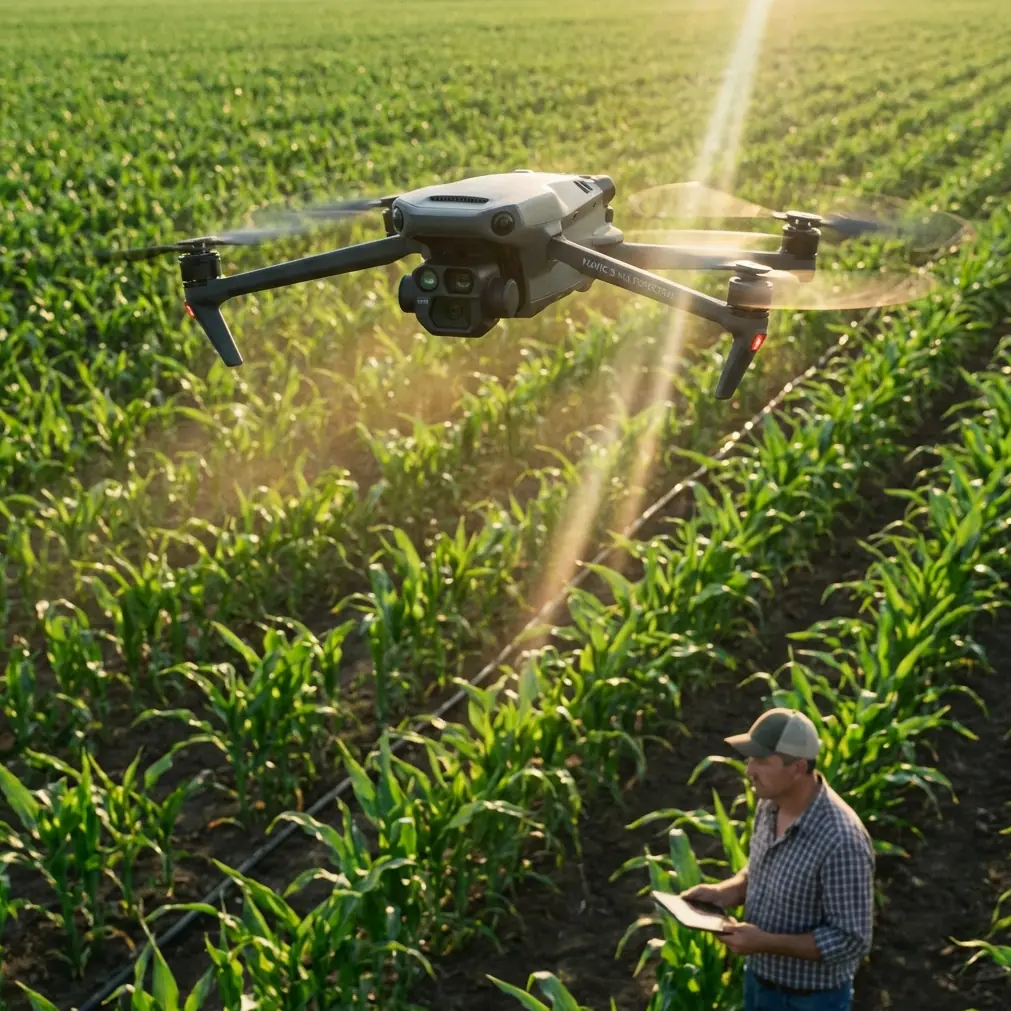
Mavic 4 Pro Field Report: Power Line Monitoring When the Weather Turns
META: A field-based look at how Mavic 4 Pro fits remote power line monitoring, with practical insight on image capture, orthomosaic workflow, DSM output, and fast response mapping.
Remote power line inspection rarely happens on a comfortable schedule. You go because a corridor needs checking, vegetation may be pushing too close, a slope near a pole looks unstable, or a storm cell passed through and someone needs eyes on the line before sending a ground team deeper into rough terrain.
That is where the Mavic 4 Pro becomes interesting—not as a spec-sheet trophy, but as a field tool inside a larger mapping and response workflow.
I approached this report from the perspective of a photographer who has spent enough time around aerial imaging to know that the aircraft is only half the story. The other half is what happens after landing: can the imagery be processed quickly, can it be turned into something useful for operations, and can a small team make decisions before daylight disappears or weather closes in again?
The reference material behind this piece points in a very specific direction. It is not about cinematic flying. It is about lightweight collection, fast response, and practical downstream outputs. One presentation on Esri’s drone application stack emphasizes exactly that balance: small-area work, quick reaction, low input burden, and heavier emphasis on application than on collection for its own sake. That matters for remote power line monitoring because many inspection tasks are not region-wide survey campaigns. They are targeted missions across a few kilometers of line, a cluster of towers, a river crossing, or a high-consequence section where access is difficult and decisions need to be made quickly.
That operating reality suits the Mavic 4 Pro mindset well.
Why a Remote Power Line Job Is Really a Data Job
When people imagine power line monitoring, they often focus on flying alongside conductors and spotting visible defects. In practice, the higher-value task is often structured image capture over a narrow corridor and around assets, followed by rapid production of usable mapping outputs.
The Esri workflow references are revealing here. Drone2Map is described as capable of handling a broad range of deliverables, including point clouds, true orthos, NDVI, DSM, 3D products, and immersive viewing outputs. Envi OneButton is highlighted for speed and for producing point clouds, orthos, and mosaic datasets. The OrthoMapping toolbox is framed as a desktop route for orthos, DSM, and mosaic datasets.
Those aren’t abstract software bullet points. For power line teams, each output answers a different operational question.
A true ortho gives a cleaner top-down visual record of the corridor and support structures, reducing the visual confusion that can happen when tall objects lean in the image. A DSM helps reveal terrain shape, embankment changes, washout risk near foundations, and vegetation height patterns. A point cloud supports closer spatial interpretation around towers, access tracks, and slopes. A mosaic dataset matters because inspection teams often need a manageable, publishable view of many images stitched into one operational layer, not a folder of disconnected files.
This is where a compact aircraft like the Mavic 4 Pro earns its place. If it can collect stable, overlap-friendly imagery in a tight weather window, then the real output is not the flight itself. The real output is a decision-ready map.
The Morning Started Clear. It Didn’t Stay That Way.
On the job that stays in my mind, the route was a remote power segment running through broken ground with limited vehicle access. The plan was simple: fly a sequence of short corridor sections, capture overlap-rich imagery around poles and terrain transitions, and get enough clean data for a same-day processing pass.
The first leg was easy. Light wind. Good visibility. Predictable light.
Then the weather shifted mid-flight.
A bank of cloud moved across faster than forecast, flattening contrast over the hillside. Wind began to pulse through the corridor. This is the sort of moment where people who only think in terms of ideal flights miss the point of field operations. Real monitoring work does not wait for perfect skies. It depends on how well your aircraft, camera discipline, and route planning absorb changing conditions without corrupting the dataset.
For remote utility work, obstacle awareness is not just a convenience feature. It is a risk control layer. Around transmission corridors, you may be dealing with uneven terrain, guy wires, trees creeping into approach paths, and shifting wind near ridgelines. The Mavic 4 Pro’s obstacle avoidance and tracking-oriented flight intelligence become operationally meaningful here because they reduce pilot load while you focus on maintaining a disciplined imaging pattern. I would still never rely blindly on automation near critical infrastructure, but in variable conditions it helps the pilot stay ahead of the aircraft rather than merely react to it.
That weather shift also changed how I thought about image consistency. Flat light is not automatically bad for mapping. In fact, it can reduce harsh shadows that obscure ground features. The problem is inconsistency—sun, then cloud, then sun again—because that complicates image matching and tonal continuity in the final orthomosaic.
The practical response was to tighten the mission logic: fewer creative deviations, stronger overlap, cleaner lines, and repeatable altitude over the key assets. The aircraft’s stability mattered. So did camera settings that protected the files for later processing.
Why Camera Discipline Still Matters on a Smart Drone
The Mavic 4 Pro conversation often drifts toward consumer-friendly flight modes like QuickShots, Hyperlapse, ActiveTrack, and subject tracking. In utility inspection, those are not the center of gravity—but they do reveal something useful about the aircraft. A platform built to hold framing reliably, interpret scene geometry, and maintain controlled motion tends to be easier to trust when flying repeatable visual documentation passes.
That said, power line monitoring is not a QuickShots job.
The real win is controlled image acquisition. If you are collecting for map products, you want consistency before style. If you are documenting specific assets, you want sharp, legible, geospatially useful frames. And if weather starts changing in-flight, flexible color handling helps. Shooting in D-Log can preserve tonal latitude that becomes valuable when cloud cover swings and reflective surfaces on insulators, metal fittings, or bare ground suddenly brighten or flatten. Even when the final deliverable is operational rather than artistic, better tonal control makes defects, terrain breaks, and vegetation boundaries easier to read.
That matters even more if the imagery is heading into a workflow designed to produce orthos, DSMs, or 3D outputs. Good inputs shorten processing friction. Bad inputs multiply it.
Small-Area, Fast-Response Missions Are Exactly the Point
One of the strongest ideas in the source material is easy to overlook because it sounds deceptively simple: drone applications often shine in small areas measured in just a few square kilometers, where rapid response matters more than giant acquisition footprints.
For remote power infrastructure, that is almost the textbook case.
You are not always mapping an entire network. You are checking the places where uncertainty is expensive: a damaged access road near a structure, a landslip below a tower pad, vegetation encroachment after growth or rain, erosion around a base, or a line section in a high-consequence area. The source pages even show sample image groups such as 28 images, 28 images, and 34 images tied to different areas and dates. That is a useful reminder that not every meaningful drone job requires hundreds upon hundreds of frames. A well-planned, targeted capture set can be enough when the mission objective is narrow and the processing path is efficient.
This is where Mavic 4 Pro-based operations can be more realistic than larger, heavier deployments. You can move quickly. Launch from constrained locations. Cover the specific segment that needs attention. Land, check the dataset, and redeploy if needed before the weather worsens.
The phrase from the source that sticks with me is the basic philosophy of light collection, heavy application. That is exactly right for utility monitoring. If your field crew can gather clean data quickly, then the operational value is created in interpretation and publication.
From Flight to Utility Decision: The Processing Chain
Let’s talk about what happens after touchdown.
The Esri materials compare three processing routes:
- Drone2Map: broad capability, multithreaded, simplified workflow, easy publication, outputs including point clouds, true orthos, NDVI, DSM, 3D, and immersive products.
- Envi OneButton: notably fast, focused on point clouds, orthos, and mosaic datasets.
- OrthoMapping toolbox: desktop-based, suitable for orthos, DSM, and mosaic datasets.
For a remote power line team using Mavic 4 Pro imagery, this comparison matters because software choice changes the speed of operational response.
If the mission is urgent and the area is compact, a workflow optimized for quick orthos and mosaic outputs may be enough to answer the question of the day: Is access compromised? Has vegetation crossed a threshold? Is there visible washout near the support? Do we need a ground crew now, later, or not at all?
If the concern is terrain change or asset context, a DSM or point cloud becomes more valuable. In mountain or gully terrain, even a modest surface model can help reveal why a line segment is becoming difficult to maintain.
And if your organization already works in ArcGIS, the publication angle is significant. A cleanly processed corridor layer that can be shared internally is far more useful than a pile of beautiful but isolated photographs. Decision-makers need a map they can interrogate, compare, and circulate.
If you need to discuss whether your corridor workflow fits better with a quick ortho pipeline or a fuller 3D deliverable, this is the sort of practical deployment question worth talking through: message our UAV workflow team directly.
What the Mid-Flight Weather Change Actually Taught
Back to the field.
Once the cloud cover thickened, the mission stopped being about ideal visuals and became about preserving data quality. That shift clarified what I value in a drone for remote utility work.
First, I need predictable flight behavior in gusts and terrain-influenced airflow. Not heroic. Predictable.
Second, I need obstacle awareness that reduces workload without making me complacent.
Third, I need camera files that survive uneven light well enough for both inspection viewing and mapping output.
Fourth, I need a platform that makes short, targeted deployments practical, because many remote line checks are measured in urgency, not acreage.
The Mavic 4 Pro fits that profile best when you think of it as one component in a fast-response geospatial system. The source documents support exactly that framing. They do not celebrate drones as flying cameras alone; they place them inside a pipeline that produces orthos, DSMs, point clouds, and publishable datasets from relatively small image collections. That is why those details matter. They connect the aircraft to real utility decisions.
Where Mavic 4 Pro Makes Sense for Power Line Monitoring
I would use this class of aircraft when the mission calls for:
- remote corridor checks over limited extents
- rapid deployment after weather events
- pole, tower, and slope context imaging
- vegetation and access-route assessment
- image collection intended for orthomosaics, DSMs, or quick GIS publication
I would be especially confident in it where conditions may shift during the sortie, provided the pilot remains disciplined and the mission objective is tightly defined.
Not every utility task requires a large enterprise aircraft. Some require speed, portability, and a mapping workflow that starts with a small drone and ends with a usable layer by the same afternoon. The Esri references make that case quietly but clearly. A drone mission over just a few square kilometers can still produce point clouds, true orthos, DSMs, and mosaic datasets that materially change maintenance planning.
That is the real story around Mavic 4 Pro in remote power line monitoring. Not glamour. Not buzzwords. A compact aerial platform that can collect reliable imagery when the weather stops cooperating, feeding a processing chain built for fast interpretation and practical action.
And in utility work, practical action is what counts.
Ready for your own Mavic 4 Pro? Contact our team for expert consultation.