
Mavic 4 Pro Guide: Monitoring Fields in Remote Areas
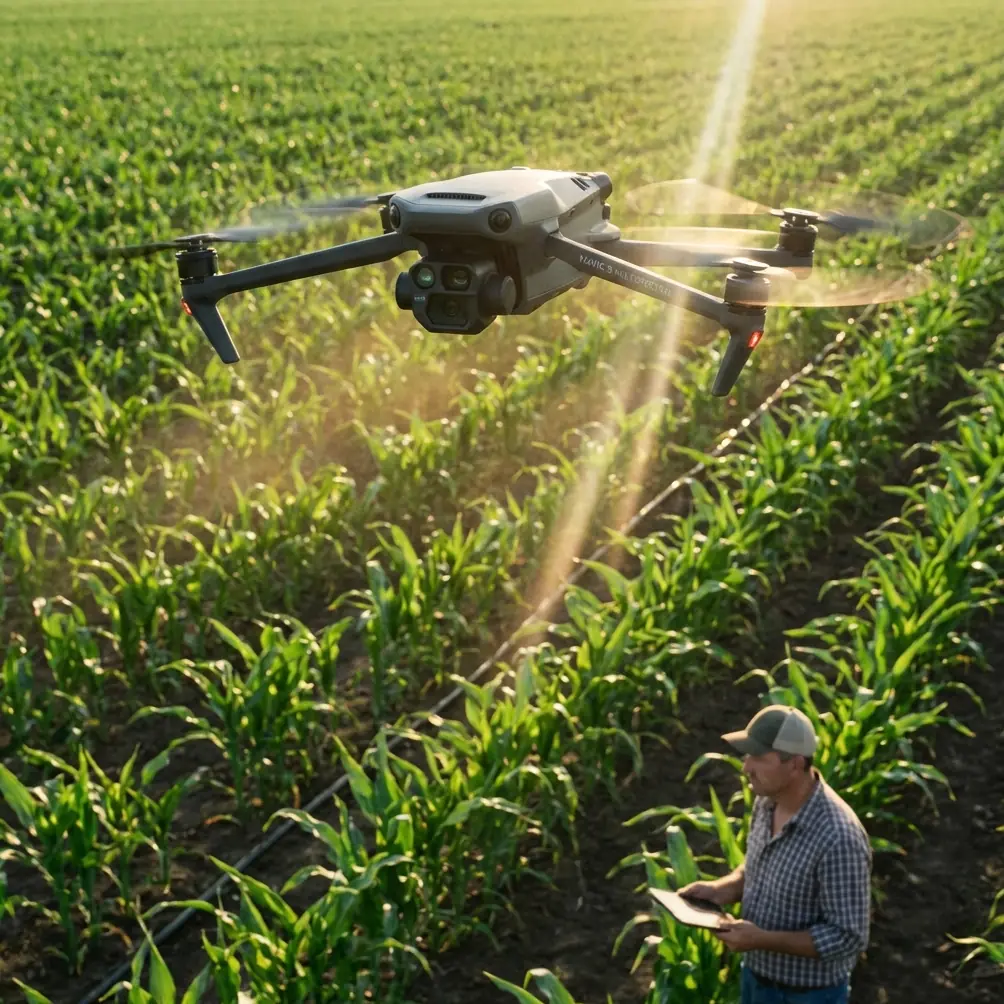
Mavic 4 Pro Guide: Monitoring Fields in Remote Areas
META: Learn how to use the Mavic 4 Pro for remote field monitoring with expert tips on antenna positioning, ActiveTrack, and D-Log settings for agricultural flights.
By Chris Park, Creator
Remote agricultural field monitoring pushes consumer drones to their absolute limits. The Mavic 4 Pro combines 100-minute max flight time (with the battery station), omnidirectional obstacle avoidance, and a Hasselblad triple-camera system that captures crop health data traditional scouting simply cannot match—this guide walks you through exactly how to set it up, fly it, and process the data for actionable field insights.
TL;DR
- Antenna positioning is the single biggest factor in maintaining signal at extended range over flat agricultural terrain—orient your controller antennas perpendicular to the drone's position for maximum gain.
- Use ActiveTrack 7.0 and pre-planned waypoint missions to automate repetitive field passes and reduce pilot workload.
- Shoot in D-Log color profile to capture the widest dynamic range for post-processing crop stress analysis.
- The Mavic 4 Pro's omnidirectional obstacle avoidance with upgraded visual sensing handles unexpected obstacles like irrigation pivots, power lines, and tree lines without manual intervention.
Why the Mavic 4 Pro Excels at Remote Field Monitoring
Agricultural monitoring isn't glamorous drone work. It's repetitive, data-heavy, and punishing on equipment. You need a platform that can handle long flights over featureless terrain, maintain a solid video link at distance, and capture imagery sharp enough for crop analysis.
The Mavic 4 Pro checks every box. Its Hasselblad camera with a 1-inch CMOS sensor delivers the resolution needed for NDVI-adjacent visual analysis. The tri-camera array (wide, medium, tele) lets you switch between broad overview shots and tight zooms on problem areas without repositioning the aircraft.
What sets it apart for agricultural users specifically is the combination of extended battery life and the upgraded O4+ transmission system, which maintains a stable HD video feed at up to 30 km (under ideal, unobstructed conditions). Flat farmland comes close to those ideal conditions—if you manage your antenna positioning correctly.
Step 1: Pre-Flight Planning for Remote Fields
Before you even power on the Mavic 4 Pro, proper planning prevents wasted battery and missed data.
Scout Your Launch Site
- Choose a launch point on elevated ground if available—even a truck bed adds meaningful range advantage over flat terrain
- Identify all obstacles within the flight path: irrigation pivots, grain bins, power lines, tree windbreaks
- Confirm GPS satellite count on the controller before launch—aim for 14+ satellites for reliable waypoint missions
- Check wind conditions at altitude, not just ground level; agricultural areas often have stronger winds at 60-120 meters AGL
Map Your Flight Path
Use the DJI Fly 2 app's waypoint mission planner to create systematic grid patterns over your fields. For standard crop health monitoring, set your passes at 80% overlap for later stitching and plan altitude between 30-60 meters AGL depending on the resolution you need.
Expert Insight: For fields larger than 50 hectares, break your mission into segments that each consume no more than 60% of a single battery. The remaining 40% covers return-to-home flight, wind resistance, and an emergency buffer. Running a battery to zero over a remote field means a long, expensive walk.
Step 2: Antenna Positioning for Maximum Range
This is where most remote monitoring operators lose signal unnecessarily. The Mavic 4 Pro's O4+ transmission is powerful, but the RC 2 controller's antennas are directional. Misalign them and your 30 km theoretical range drops to a fraction of that.
The Golden Rule
Keep both controller antennas perpendicular to the drone's position—the flat faces of the antennas should point directly at the aircraft. As the drone moves across a field, rotate your body to maintain this alignment.
Positioning Tips for Flat Terrain
- Never point the antenna tips at the drone—this is the antenna's weakest radiation point (the null zone)
- If the drone is directly overhead, angle antennas outward at roughly 45 degrees from vertical
- Keep the controller at chest height—holding it low introduces ground-reflection interference
- Avoid standing near metal structures, vehicles with running engines, or other 2.4 GHz / 5.8 GHz sources
Signal Loss Protocol
Program your Return-to-Home altitude to at least 20 meters above the tallest obstacle in the area. On flat farmland, 50 meters RTH altitude provides ample clearance for power lines and equipment while keeping the drone within easy visual reacquisition range.
Step 3: Camera Settings for Crop Monitoring
Why D-Log Matters for Agriculture
Shooting in D-Log color profile preserves highlight and shadow detail that standard color profiles crush. When you're analyzing crop imagery later—looking for subtle color variations that indicate water stress, nutrient deficiency, or pest damage—that extra dynamic range is the difference between actionable data and guesswork.
- Set color profile to D-Log or D-Log M
- Shoot at 4K 30fps minimum for video passes; 48MP stills for stitched orthomosaics
- Use manual exposure: set ISO to 100-200, let shutter speed adjust, and lock white balance to Sunny or a custom Kelvin value
- Avoid auto settings—they shift between frames and create inconsistencies in your dataset
Leveraging the Triple Camera
| Camera | Focal Length | Best Use in Field Monitoring |
|---|---|---|
| Wide | 15mm equivalent | Full-field overview passes, stitched maps |
| Medium | 35mm equivalent | Row-level detail, irrigation coverage checks |
| Telephoto | 105mm equivalent | Targeted inspection of problem spots, pest ID |
Switch between lenses mid-mission using the camera toggle rather than flying the drone closer. This saves battery and maintains your grid pattern integrity.
Step 4: Automated Flight Features That Save Time
ActiveTrack 7.0 for Linear Features
Use ActiveTrack to follow fence lines, drainage ditches, or field borders. The Mavic 4 Pro's upgraded subject tracking locks onto linear features and maintains consistent framing, freeing you to monitor the video feed for anomalies rather than manually piloting.
Waypoint Missions With Hyperlapse
For long-term monitoring, fly the exact same waypoint mission weekly and compile the results into a Hyperlapse sequence. This creates a time-compressed visual record of crop growth, irrigation changes, and seasonal patterns that's invaluable for planning.
QuickShots for Client-Facing Content
If you're monitoring fields for a farm client and need polished deliverables, QuickShots modes (Dronie, Rocket, Circle) produce professional-looking overview footage in seconds. Combine these with your analytical data to create reports that communicate findings visually.
Pro Tip: When running automated waypoint missions, always keep your thumb near the pause button. Obstacle avoidance handles most hazards, but a suddenly raised irrigation pivot arm or a crop duster entering your airspace requires immediate manual override. Automation assists—it doesn't replace—pilot vigilance.
Step 5: Post-Flight Data Processing
- Import D-Log footage into DaVinci Resolve or Adobe Premiere and apply a LUT designed for DJI D-Log to restore natural colors before analysis
- Use orthomosaic stitching software (Pix4D, DroneDeploy, or OpenDroneMap) on still captures for georeferenced field maps
- Compare weekly data sets to identify change over time—this reveals developing issues before they're visible from ground level
- Archive all flight logs and raw imagery with GPS metadata for regulatory compliance and historical record
Technical Comparison: Mavic 4 Pro vs. Common Agricultural Monitoring Alternatives
| Feature | Mavic 4 Pro | Typical Fixed-Wing Ag Drone | Previous-Gen Mavic 3 Pro |
|---|---|---|---|
| Max Flight Time | 46 min (single battery) | 60-90 min | 43 min |
| Obstacle Avoidance | Omnidirectional | None | Omnidirectional |
| Camera System | Triple Hasselblad | Single mapping sensor | Triple Hasselblad |
| Transmission Range | 30 km (O4+) | Variable (often RC link) | 20 km (O4) |
| Portability | Foldable, backpack-ready | Requires vehicle transport | Foldable, backpack-ready |
| Subject Tracking | ActiveTrack 7.0 | Not available | ActiveTrack 6.0 |
| Wind Resistance | Up to 12 m/s | Higher | Up to 12 m/s |
| Setup Time | Under 3 minutes | 15-30 minutes | Under 3 minutes |
The fixed-wing platform wins on raw endurance, but the Mavic 4 Pro's portability, obstacle avoidance, and camera versatility make it the superior choice for operators who monitor multiple remote sites in a single day.
Common Mistakes to Avoid
- Ignoring antenna orientation: This single error accounts for more "signal lost" incidents over farmland than any equipment failure. Practice rotating with the drone's position until it becomes automatic.
- Flying at noon: Harsh overhead sunlight washes out crop color variations. The best monitoring data comes from flights during golden hour or under consistent overcast skies.
- Using auto white balance: When your entire analysis depends on comparing color data across frames and across weeks, auto WB introduces uncontrollable variables. Lock it manually.
- Skipping preflight obstacle mapping: A power line you didn't notice on your planning map can end a flight—and a drone—instantly. Obstacle avoidance is a safety net, not a navigation strategy.
- Draining batteries completely: Consistently discharging below 20% degrades LiPo battery health rapidly. Land at 25-30% remaining to preserve long-term battery performance and maintain your emergency margin.
- Neglecting firmware updates: DJI frequently pushes obstacle avoidance algorithm improvements and transmission stability patches. Flying outdated firmware in remote areas means missing reliability upgrades you need most.
Frequently Asked Questions
How far can the Mavic 4 Pro reliably fly over flat agricultural land?
Real-world range over flat, unobstructed farmland typically reaches 12-20 km with proper antenna positioning and no electromagnetic interference. This is well beyond visual line of sight, so always comply with local aviation regulations—many jurisdictions require a waiver or exemption for BVLOS operations. The O4+ system maintains HD feed quality at these distances when antennas are correctly oriented.
Can the Mavic 4 Pro replace dedicated multispectral agriculture drones?
Not entirely. The Mavic 4 Pro's RGB cameras capture visible-light data that reveals many crop health indicators, but dedicated multispectral sensors (capturing NIR, Red Edge, and other bands) provide deeper agronomic analysis. The Mavic 4 Pro serves as an excellent first-line scouting tool and produces more than enough data for general crop monitoring, irrigation verification, and damage assessment. For precision variable-rate application mapping, a multispectral platform remains the better tool.
What is the best altitude for agricultural field monitoring with the Mavic 4 Pro?
For general crop health overview, fly at 50-60 meters AGL using the wide camera. This balances ground resolution with coverage area per pass. For detailed row-level inspection or pest identification, drop to 20-30 meters AGL and use the medium or telephoto lens. Always plan altitude based on your specific data resolution needs—lower altitude means higher resolution but more passes to cover the same area, which consumes additional battery.
Ready for your own Mavic 4 Pro? Contact our team for expert consultation.