
Mavic 4 Pro Field Report: Mapping Fields in Low Light
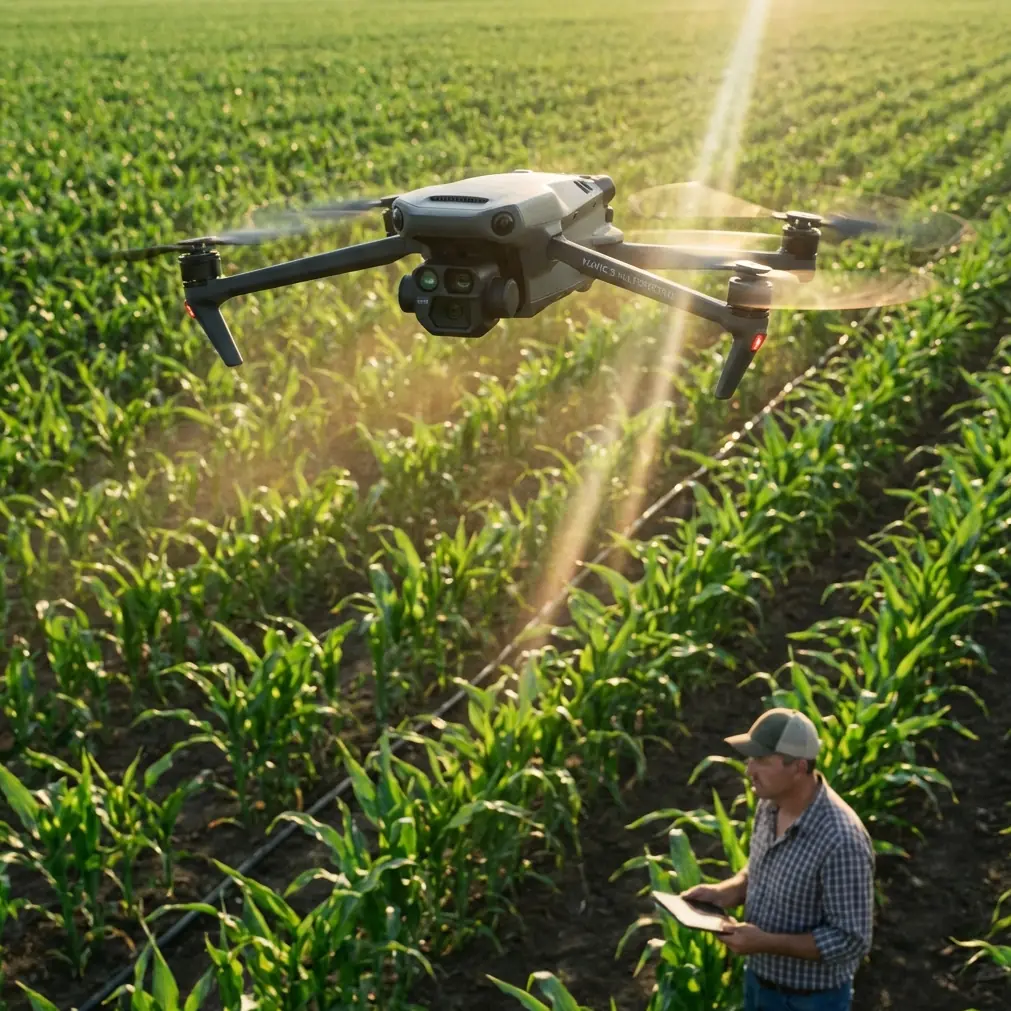
Mavic 4 Pro Field Report: Mapping Fields in Low Light Without Losing Survey Discipline
META: A field-tested look at using Mavic 4 Pro for low-light field mapping, with practical lessons drawn from corridor survey workflows, 3D reconstruction needs, battery management, and safe data capture.
I spend a lot of time around camera drones, but low-light mapping is where the marketing language usually falls apart. Pretty footage is easy to promise. Reliable survey-grade capture when the light is fading, terrain is uneven, and the site stretches farther than expected—that is the real test.
For this field report, I want to frame the Mavic 4 Pro in a way that actually matters to operators mapping agricultural land and long field corridors near access roads, drainage cuts, embankments, and scattered structures. Not as a lifestyle aircraft. As a working camera platform.
The most useful reference point here comes from a road and railway survey workflow built around two very different UAV types. In that solution, a multirotor platform is valued for one simple reason: camera angle flexibility. That sounds basic until you work on narrow or irregular sites where terrain changes quickly and the useful details are not directly beneath the aircraft. Fences, berms, culverts, tunnel entries, elevated sections, and edge conditions all benefit from oblique views, not just top-down passes. The same logic carries directly into field mapping at dusk.
That is where the Mavic 4 Pro earns attention.
Why low-light field mapping is not just “normal mapping with less sun”
When people say they need to map fields in low light, the assumption is usually that they just want the drone to see in dim conditions. In practice, the problem is more layered.
At the end of the day, the field itself often still reads clearly from above, but the boundaries do not. Drainage channels disappear into shadow. Access tracks flatten out. Fence lines merge with hedgerows. Small grade changes that matter for runoff planning or equipment access stop showing obvious contrast. If there are utility poles, sheds, pump houses, or raised road approaches around the perimeter, they can turn into dark shape blocks rather than usable reference features.
This is why the reference material’s emphasis on three-dimensional scene reconstruction is so relevant. In that road survey workflow, the goal was not merely image collection. It was to reconstruct spatial conditions in a way that made embankments, fences, tunnels, and elevated structures easy to understand and manage. For agricultural readers, swap those assets for terraces, irrigation features, windbreaks, retention ponds, and field access routes. The principle is the same: if the light is poor, structure matters more than color.
A capable drone in low light needs to do three things well:
- Hold a stable line with minimal correction.
- Capture enough angled detail to preserve structure.
- Avoid wasting battery on indecisive flight behavior.
The Mavic 4 Pro fits this kind of work best when you treat it less like a point-and-shoot flyer and more like a compact corridor-mapping tool.
The lesson from larger survey aircraft: efficiency is operational, not theoretical
One of the most useful facts in the source material is not about image quality at all. It is the fixed-wing iFly U3’s mission profile: 90 minutes of endurance, 85 km/h cruise speed, 20 km control radius, and a setup time of 10 minutes. It also uses catapult launch and fixed-point parachute landing. That aircraft exists for coverage and efficiency.
Now, the Mavic 4 Pro is not a fixed-wing platform, and it should not be evaluated as one. But the comparison is still operationally valuable. It highlights the real tradeoff in field mapping:
- fixed-wing systems cover long, linear areas efficiently
- multirotors win where angle control, local detail, and site adaptability matter more
Low-light field mapping usually favors the second category, especially when the job includes variable terrain or edge inspection. You may not need to map hundreds of hectares in one sortie. You may need to document a complex field boundary, drainage issue, damaged access lane, or crop-area transition right before visibility falls off. In those moments, the Mavic 4 Pro’s ability to pause, reframe, orbit, and capture oblique views safely is more useful than brute-area endurance.
That same source also notes a key advantage of multirotors in corridor inspection: they can get closer to the target and capture richer detail than traditional manual line inspection. Again, that maps directly to field work. If you are checking washout along a farm road, standing water around a low corner, or the shape of an embankment after weather, closeness matters. Detail matters. Flexible approach angles matter.
Oblique capture is the difference between a pretty map and a useful one
This is the part many operators still underestimate.
For low-light mapping, a clean nadir grid is not always enough. If your end product is only a flat orthomosaic, you may produce a technically complete map that still hides the practical story of the site. The source workflow explicitly uses multi-angle image acquisition first, then 3D reconstruction, then refined modeling and vector extraction. That sequence matters because it turns raw imagery into something managers can act on.
With the Mavic 4 Pro, this means building a flight plan that includes more than one pass type:
- a primary mapping grid for coverage
- a lower-speed oblique perimeter pass for edges and structures
- selective close-range captures of drainage, access points, and problem zones
This is where features people associate with creative flying can quietly become useful field tools. Subject tracking and ActiveTrack are usually discussed in cinematic terms, but in non-sensitive civilian site work they can help maintain consistent framing around moving farm equipment demonstrations or inspection vehicles without forcing the pilot into constant stick correction. Hyperlapse and QuickShots are not mapping outputs, but they can support progress communication for landowners, agronomists, and project stakeholders who need a fast visual summary before the full reconstruction is processed.
D-Log also has a place here. Not because every farmer wants to color grade footage, but because low-light scenes often compress highlights and shadows in ugly ways. If you are documenting field edges under uneven illumination—say, a bright western horizon and dark ground detail—having more flexibility in tonal recovery can preserve reference detail that would otherwise disappear.
A battery management tip I learned the hard way
Here is the field habit I wish more operators would adopt: do not launch a low-light mapping mission on a battery that was already used for scouting, even if the percentage still looks comfortable.
The reason is simple. Late in the day, your margin is thinner than the app suggests.
As the air cools, the return leg can be less forgiving, especially if you spent the first part of the session hovering, reframing, and making small corrections around obstacles or uneven terrain. Add one more oblique pass because the shadows looked better from the south edge, and suddenly the “safe enough” battery is the battery that forces you to cut the most important segment.
I now keep one battery reserved specifically for the final structured map run. Scouting, angle checks, and test exposures happen on another pack. The reserved battery is warmed, fresh, and used only when the mission geometry is settled. This sounds minor until you are trying to finish a perimeter pass over a long field boundary near trees, irrigation rigs, or utility crossings in failing light.
It is the multirotor equivalent of respecting the disciplined efficiency that larger survey aircraft are built around. The fixed-wing reference platform’s 90-minute endurance sounds luxurious, but the deeper lesson is planning. Coverage depends on mission design, not optimism.
Obstacle avoidance matters more at the edge of the frame
Low-light field mapping often happens in places that look open from overhead but are messy around the margins. Shelterbelts, wires near access roads, isolated sheds, gate structures, pumping equipment, and tall crop edges all create risk during setup passes and manual repositioning.
That is where obstacle avoidance is not a luxury feature. It is workload reduction.
The source document mentions an environment where long, narrow routes and changing terrain make UAVs particularly useful for spatial understanding. Anyone flying fields near roads or drainage corridors knows the same pattern. The open center is easy. The edges are where the work is. If the aircraft can help you manage those transitions, you preserve more attention for image consistency and overlap discipline.
I still do not rely blindly on automated sensing in dim conditions, especially near thin wires or low-contrast vegetation. But when the Mavic 4 Pro can reduce the number of abrupt manual corrections, that improves the mission in two ways: safer flight and cleaner data capture. Repeated braking, yaw twitch, or improvised path changes can leave you with inconsistent imagery right where your stakeholders are most likely to ask questions.
Real mapping value is in what can be extracted later
Another underappreciated detail in the reference workflow is the use of a modeling and mapping software chain that supports refined modeling and 2D vector extraction from reconstructed scenes. That is a serious clue about what good capture should aim toward.
The drone’s job is not finished when the memory card is full.
If your low-light field mission is meant to support actual land decisions, then the imagery should allow later extraction of usable features: field boundaries, access tracks, drainage lines, erosion edges, fence alignments, structure footprints, and elevation-related interpretation. Capture choices should serve that downstream need.
This is exactly why flexible-angle image collection is operationally significant. In dim conditions, oblique imagery often preserves edge definition that a top-down-only mission may fail to separate. If a reconstructed scene gives you a clearer read on a berm, a retaining edge, or a narrow drainage cut, then the extra pass paid for itself.
If you are planning this kind of workflow regularly and want to compare mission setups with someone who understands both imaging and field operations, I’d suggest starting with a practical conversation here: message a drone workflow specialist.
How I would fly the Mavic 4 Pro on a low-light field job
Not a generic template. A realistic sequence.
1. Scout quickly, but do not overshoot the battery budget
Use an initial battery for altitude check, obstacle review, and light assessment. Identify the darkest boundary and the highest-risk edge.
2. Build the main map run around the weakest lighting zone
Do not start with the easiest section. Start where detail will disappear first. If the west edge is already losing contrast, capture it before the center.
3. Add oblique perimeter coverage
This is where the multirotor logic from corridor reconstruction becomes valuable. Side views and angled passes often save the interpretation of ditches, berms, roads, and built features.
4. Keep flight speed conservative near edges
The fixed-wing benchmark of 85 km/h underlines how purpose-built platforms trade speed for coverage. A multirotor should do the opposite when detail is the priority. Slow down where shape definition matters.
5. Reserve one battery for the committed mission
No exceptions. If the light is falling, battery indecision is expensive.
6. Capture a short visual summary set
A brief ActiveTrack, manual orbit, or carefully planned QuickShot-style sequence can help communicate site conditions to non-technical stakeholders before full processing is done.
Where Mavic 4 Pro makes the most sense in this workflow
For large, monotonous acreage, fixed-wing logic still wins on raw efficiency. The source data makes that obvious. An aircraft with 90 minutes of endurance, 20 km control radius, and autonomous procedures is built to finish long coverage tasks fast.
But low-light agricultural mapping is often not a pure acreage problem. It is a visibility, edge-definition, and interpretability problem. That is exactly where a drone like the Mavic 4 Pro becomes useful. It can work the awkward margins, collect the angle-rich data that supports 3D understanding, and adapt quickly when the terrain or the assignment changes.
That flexibility has real consequences on the final deliverable. A map is one thing. A site model that helps someone understand why water is pooling, where access is compromised, or how a boundary feature has changed—that is where the aircraft proves its value.
And that, more than any spec sheet headline, is the standard I would use for evaluating it in the field.
Ready for your own Mavic 4 Pro? Contact our team for expert consultation.