
Mavic 4 Pro in Complex Terrain: A Field Capture Case Study
Mavic 4 Pro in Complex Terrain: A Field Capture Case Study From the Hills
META: A practical Mavic 4 Pro field case study covering obstacle avoidance, ActiveTrack, D-Log workflow, Hyperlapse planning, and antenna adjustment for electromagnetic interference in difficult terrain.
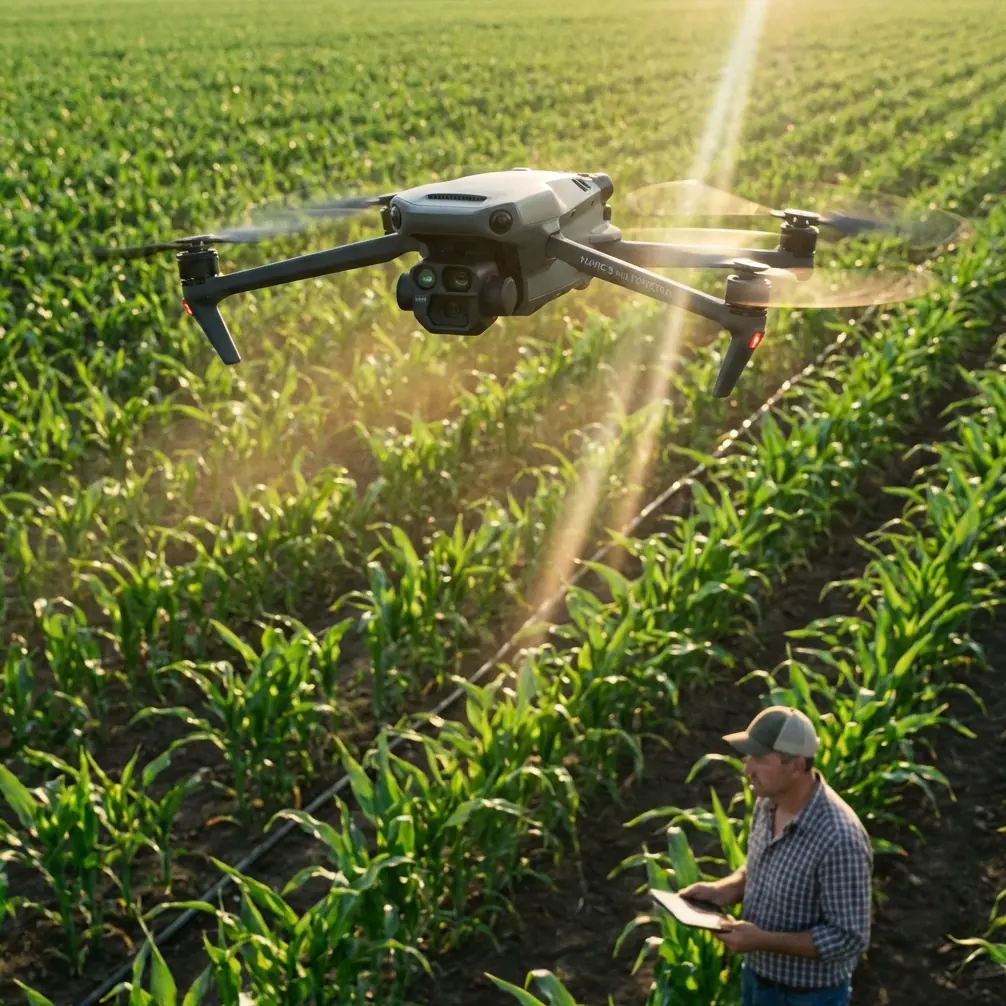
I took the Mavic 4 Pro into broken agricultural terrain for a job that sounds simple until you are standing in it: document working fields spread across ridgelines, tree breaks, irrigation hardware, and uneven access roads without losing continuity from one parcel to the next.
That kind of assignment exposes the difference between a drone that looks good on paper and one that holds together when the landscape starts interfering with the mission. Open farmland is easy to imagine as empty airspace. In reality, fields in complex terrain are full of traps. Tree lines rise suddenly from contour edges. Metal sheds and power infrastructure sit where you least want them. Valleys distort line of sight. Even radio behavior can change as you move from a clean ridge into a pocket full of reflective surfaces and electrical equipment.
This is where the Mavic 4 Pro becomes interesting, not as a spec-sheet object but as a working camera platform.
The Assignment: Map the Story, Not Just the Acreage
The brief was to capture several fields that did not behave like one large open block. The property was split by elevation, narrow access tracks, and pockets of infrastructure. The client wanted more than a straight overhead survey aesthetic. They needed footage that explained the land: how one field connected to another, where terrain constrained machinery movement, and how drainage and crop layout changed from slope to slope.
That meant four visual jobs at once.
First, wide establishing shots to explain the geography.
Second, lower-altitude tracking runs to show usable access lanes and field boundaries.
Third, repeatable passes for editing consistency.
Fourth, cinematic inserts that would keep the final film from feeling like a pure documentation exercise.
The Mavic 4 Pro is particularly effective in this kind of mixed mission because its toolset spans both safety and presentation. Obstacle avoidance matters when the terrain forces low and lateral movement. ActiveTrack matters when the subject is not a person jogging on a beach but a tractor, utility vehicle, or moving inspection route passing in and out of partial cover. D-Log matters because fields are some of the hardest environments to grade cleanly: bright sky, reflective water, dark hedgerows, and textured soil all compete in the same frame.
Those features are familiar by name. Their value becomes real when the terrain stops cooperating.
The First Problem Was Not Wind. It Was Interference.
Most pilots heading into fields think first about weather, battery timing, and line of sight. All correct. On this job, the issue that needed active management was electromagnetic interference.
One edge of the route ran near utility hardware and metal-roofed farm structures. Not enough to stop the mission, but enough to create inconsistent link behavior if the aircraft orientation and controller position were treated casually. This is where pilots often make a preventable mistake: they assume a strong drone will simply brute-force through a noisy environment.
That is the wrong mindset.
With the Mavic 4 Pro, antenna adjustment is not a trivial habit. It is operational discipline. When the aircraft dropped into a lower section beyond a rise, I changed my controller stance and antenna alignment deliberately rather than waiting for the signal to degrade further. That small correction stabilized the link margin and reduced the chance of compounding problems while framing a shot.
The practical lesson is simple. In terrain with reflective metal surfaces, electrical infrastructure, or changing elevation, do not point yourself at the monitor and forget the radio path. Re-orient your body. Re-angle the antennas. Move a few steps if needed. The drone may still be visible, but the quality of the connection can shift quickly when ridges and structures begin interacting with the signal.
For field work, this matters more than many camera settings. If you lose confidence in the link, you stop flying the shot and start babysitting the aircraft. Once that happens, consistency disappears.
Obstacle Avoidance Changes How Aggressively You Can Work the Edges
Fields with complex terrain rarely look dramatic from directly above. The shape of the land reveals itself from oblique angles, often at lower altitudes, where terraces, access ruts, drainage cuts, fence lines, and crop transitions actually read in the image.
That is exactly where risk increases.
The Mavic 4 Pro’s obstacle avoidance is not a substitute for judgment, but it expands the envelope for useful work near tree margins and infrastructure. On one pass, I needed to hold a lateral line along the edge of a sloping field while preserving foreground texture from the crop rows. The temptation in a manual flight is to back off too far, sacrificing depth and making the terrain look flatter than it is. With reliable obstacle sensing supporting the move, I could keep the aircraft closer to the edge geometry and maintain a more informative composition.
That is operational significance, not marketing language. The feature did not just make the flight “safer.” It changed the footage. It allowed a line that better communicated the actual topography.
In agricultural filming, that distinction is huge. A field can appear gentle in a high, wide shot and operationally demanding in reality. Low-angle passes are what reveal that truth.
ActiveTrack Was Useful, But Only When Used Selectively
A lot of drone operators talk about subject tracking as if it is universally useful. It is not. In agricultural terrain, ActiveTrack becomes valuable when the subject has a clear role in explaining the land.
On this job, I used it for moving equipment on a boundary route rather than treating it as a novelty. That meant the machine became a scale reference and a narrative device. Viewers could immediately understand gradient, spacing, and field access because a moving subject was interacting with those elements in frame.
The important part was deciding when not to use it.
In areas where the route crossed behind partial tree cover or near vertical clutter, I switched back to more direct flight control rather than asking the tracking system to solve every visual interruption. The Mavic 4 Pro’s subject tracking tools are strongest when they support the shot concept, not when they are forced into every segment of the mission.
That selective use also protects edit continuity. If one clip relies heavily on automated tracking behavior and the next is a carefully flown manual pass, the viewer can feel the difference in movement quality. The best results came from blending ActiveTrack with intentional manual repositioning so the sequence felt coherent from field to field.
QuickShots and Hyperlapse Only Help If the Story Is Already Clear
The easiest way to waste time on a field job is to collect clever-looking clips that do not answer the client’s actual needs.
QuickShots have value here, but only after the essential geography is covered. A short reveal move from behind a hedgerow into a full field opening can explain scale quickly. Used once or twice, it adds rhythm and helps the edit breathe. Used too often, it turns serious land documentation into a demo reel.
Hyperlapse was more strategically useful than I expected. In uneven terrain, time-compressed movement can show weather drift, light progression across ridges, or the relationship between active work zones and the broader landscape. I set it up only after the main flight objectives were secured, choosing a position that held a strong view over multiple field layers rather than chasing a dramatic sky for its own sake.
This is where the Mavic 4 Pro works well for disciplined operators. It offers creative modes that can strengthen a field story, but they do not force themselves onto the mission. The platform lets you decide whether the terrain deserves a utility-first treatment, a cinematic treatment, or a combination of both.
D-Log Was Essential Because Farmland Is a High-Contrast Trap
People often reserve log capture talk for commercial productions and overlook how important it is in agricultural imagery. That is a mistake.
Fields in difficult terrain produce brutal contrast. You can have bright cloud gaps, shaded tree lines, reflective irrigation surfaces, dark soil bands, and pale tracks all inside one shot. Standard profiles can look clean on the controller and still fall apart in grading when you try to recover highlight detail without crushing texture in the land.
D-Log gave me the flexibility to hold the sky and preserve subtle tonal separation in the fields. That matters because agricultural footage is judged on information as much as beauty. If the viewer cannot distinguish contour changes, crop pattern shifts, or the edge between worked and unworked ground, the footage loses practical value.
On this job, the grade was not about making everything dramatic. It was about preserving honesty. The hills needed to look like hills, not flat green patches under a pretty sunset treatment.
If your end use includes client review, land presentation, planning discussion, or repeat comparison over time, this matters even more. A flatter capture profile gives you more room to produce a consistent look across changing light conditions, which is common when moving between exposed ridges and sheltered low sections.
Battery Planning Was Really Terrain Planning
The common habit is to think in terms of flight minutes. For field work in broken terrain, that is too simplistic. Battery strategy is really terrain strategy.
Each segment of this mission had a different workload. One section was mostly stable forward motion over an open slope. Another required repeated repositioning near vertical obstacles and more cautious pacing because of infrastructure and changing elevation. Those are not equal battery environments, even if they occupy similar map area.
The Mavic 4 Pro’s efficiency is useful, but the real advantage comes when the pilot plans flights by terrain complexity rather than by acreage alone. I broke the job into visual zones, not just geographical zones. That reduced rushed decision-making late in a flight and made it easier to preserve margin for return and repositioning if the radio environment changed again.
That discipline also helps when you need one more take. If the battery plan is built on a realistic understanding of the terrain, you can decide whether that extra pass is reasonable instead of gambling because the percentage number still looks comfortable.
What the Mavic 4 Pro Did Best on This Job
What stood out was not any single feature in isolation. It was the way the aircraft supported a layered mission.
Obstacle avoidance made low terrain-revealing passes more viable.
ActiveTrack helped turn moving equipment into useful visual context.
QuickShots and Hyperlapse added editorial variety once the core coverage was secure.
D-Log preserved field detail under mixed lighting.
And antenna adjustment in response to electromagnetic interference kept the mission stable when the environment started pushing back.
That last point deserves emphasis because it is easy to ignore until a day goes sideways. Pilots often spend hours learning camera settings and very little time refining signal awareness. In complex agricultural terrain, that balance should be reversed. A perfectly exposed clip is worthless if the link becomes unreliable halfway through the move.
If you are planning similar work and want a second set of eyes on route design or signal strategy, you can message me directly through this field workflow contact: https://wa.me/example
Final Take for Pilots Working Fields
The Mavic 4 Pro is a strong tool for field capture, but not because it magically simplifies difficult terrain. Its value is that it gives a prepared pilot more options without immediately punishing ambition.
That is a meaningful difference.
In open, flat farmland, almost any competent drone can gather usable imagery. In segmented land with ridges, trees, reflective surfaces, and working infrastructure, the mission becomes less about simple flying and more about managing relationships: aircraft to terrain, radio path to elevation, subject movement to shot structure, color profile to contrast.
This case reminded me that the best field footage does not come from chasing spectacle. It comes from reading the land accurately and using the aircraft’s systems at the right moments. The Mavic 4 Pro delivered that balance well. It stayed precise where the terrain tightened, flexible where the story needed variety, and resilient enough to keep the job moving after interference started to show itself.
For anyone capturing fields in complex terrain, that combination is what counts.
Ready for your own Mavic 4 Pro? Contact our team for expert consultation.